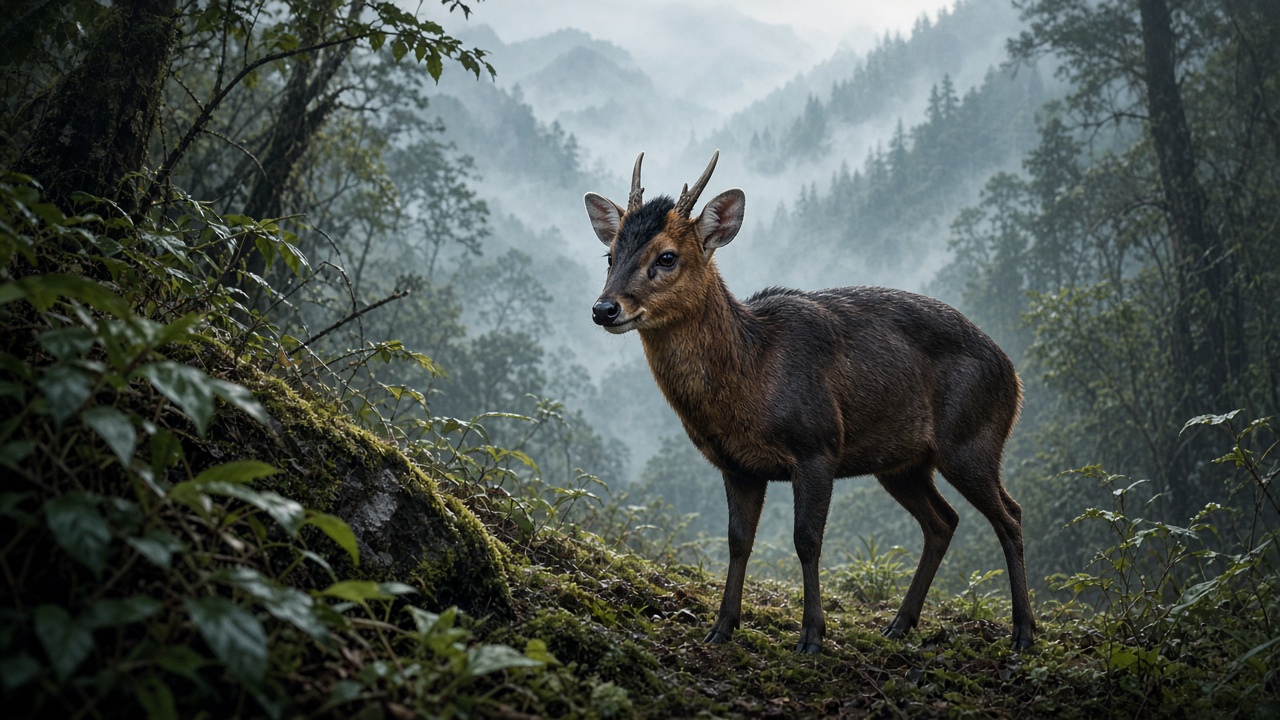
Black Muntjac
Muntiacus crinifronsNo solid country presence documented yet.
Black Muntjac (Muntiacus crinifrons): biology, habitats and field signs across its documented range, hunting-context reading.
Overview
Black Muntjac (Muntiacus crinifrons) is presented here in a hunting-context reading across its documented range: biology, habitats and field signs useful to observers — without publishing season, quota or authorisation.
Classification: order Artiodactyla, family Cervidae, genus Muntiacus. Common names: Black Muntjac in English, Muntjac noir in French, Muntíaco negro in Spanish.
Identification
One of the larger muntjacs, the black muntjac measures 98 to 113 cm and weighs 21.3 to 36.1 kg; unusually, females average slightly heavier than males. The coat is black to dark brown, barely paler below, thicker and darker in winter. A long cinnamon-red frontal tuft often hides the long antler pedicles. The tail, about 21 cm, is notably longer than in other muntjacs and thickly white underneath. Males carry short, unbranched antlers and upper canines elongated into tusks; fawns show four rows of white spots.
A herbivore, it eats leaves, twigs and fruit: woody shrubs and vines, fallen fruit, herbs and grasses, conifers and bamboo leaves, with no animal matter found in the rumen contents studied. Solitary and territorial, it breeds year-round without a distinct season; females bear a single fawn and can be pregnant while still nursing. The spotted fawn stays hidden in the undergrowth before following its mother. The dhole is one of its main predators.
Habitats and range
MDD lists it from China; ADW specifies Anhui, Fujian, Jiangxi and Zhejiang provinces and also records it in Hkakabo Razi National Park in northern Myanmar. Its former range was probably wider and has been fragmented by deforestation. It uses hilly, often precipitous mountain forest between 800 and 1,000 m: a mosaic of deciduous broadleaf, evergreen and bamboo patches with dense undergrowth under subtropical monsoon conditions.
The countries where the species’ presence is established are shown in the tags on this sheet.
Field signs
It marks its territory by rubbing secretions from its frontal and preorbital glands on vegetation. When anxious or in conflict it gives a deep bark, raises its long tail to flash the white underside and erects its red frontal tuft. Males defend their territory with their tusks and share it with no other deer species.
Conservation
For conservation status of Muntiacus crinifrons, consult the current IUCN assessment and cross with national monitoring programmes in countries of documented presence. Never turn a global IUCN category into a local hunting rule. GBIF occurrences help situate distribution but remain effort-biased.
The IUCN lists it as Vulnerable; it is on CITES Appendix I. The threats described are habitat loss (logging, clearance for farming, infrastructure) and overexploitation for meat and skins. In China, the population estimated at about 10,000 animals in the early 1980s was revised to 5,000 to 6,000 in 1989.
Limits
This sheet on the Black Muntjac publishes no season, quota, hunting method or fee: those rules differ between countries and territories and must be checked in official texts. Being described here does not mean a species may be hunted.
Local densities and management plans are not covered here: they are a matter for the managers of each area.
Sources
Sources consulted for this sheet:
- IUCN Red List — species search (consulted 2026-11-02)
- ASM Mammal Diversity Database — Muntiacus crinifrons (consulted 2026-11-02)
- GBIF — species search (consulted 2026-11-02)
- Animal Diversity Web — Muntiacus crinifrons (black muntjac) (consulted 2026-11-04)
Conclusion
In short: use the scientific name Muntiacus crinifrons to cross-check sources, confirm taxonomy and conservation status on the institutional portals listed above, and relate every field sign to the habitat where it was actually found.
Identification
Muntiacus crinifrons
Muntjac noir · preferred
Muntíaco negro · preferred
Black Muntjac · preferred
Hairy-fronted Muntjac
Classification
Class : Mammalia
Order : Artiodactyla
Family : Cervidae
Genus : Muntiacus
Conservation
IUCN : VU
CITES : —
iucn · VU (global)
Frequently asked questions
How do I recognise Black Muntjac?
Use Muntiacus crinifrons as the scientific anchor. One of the larger muntjacs, the black muntjac measures 98 to 113 cm and weighs 21.3 to 36.1 kg; unusually, females average slightly heavier than males. The coat is black to dark brown, barely paler below, thicker and darker in winter. A long cinnamon-red frontal tuft often hides...
Where does Black Muntjac typically live?
MDD lists it from China; ADW specifies Anhui, Fujian, Jiangxi and Zhejiang provinces and also records it in Hkakabo Razi National Park in northern Myanmar. Its former range was probably wider and has been fragmented by deforestation. It uses hilly, often precipitous mountain forest between 800 and 1,000 m: a mosaic of deciduous broadleaf, evergreen and bambo...
What field signs help confirm Black Muntjac?
It marks its territory by rubbing secretions from its frontal and preorbital glands on vegetation. When anxious or in conflict it gives a deep bark, raises its long tail to flash the white underside and erects its red frontal tuft. Males defend their territory with their tusks and share it with no other deer species.