Honey Badger
Mellivora capensisHoney Badger (Mellivora capensis): biology, habitats and field signs across its documented range, hunting-context reading.
Seen in: Namibia · South Africa
Overview
Honey Badger (Mellivora capensis) is presented here in a hunting-context reading across its documented range: biology, habitats and field signs useful to observers — without publishing season, quota or authorisation.
Classification: order Carnivora, family Mustelidae, genus Mellivora. Common names: Honey Badger in English, Ratel in French, Ratel in Spanish.
Identification
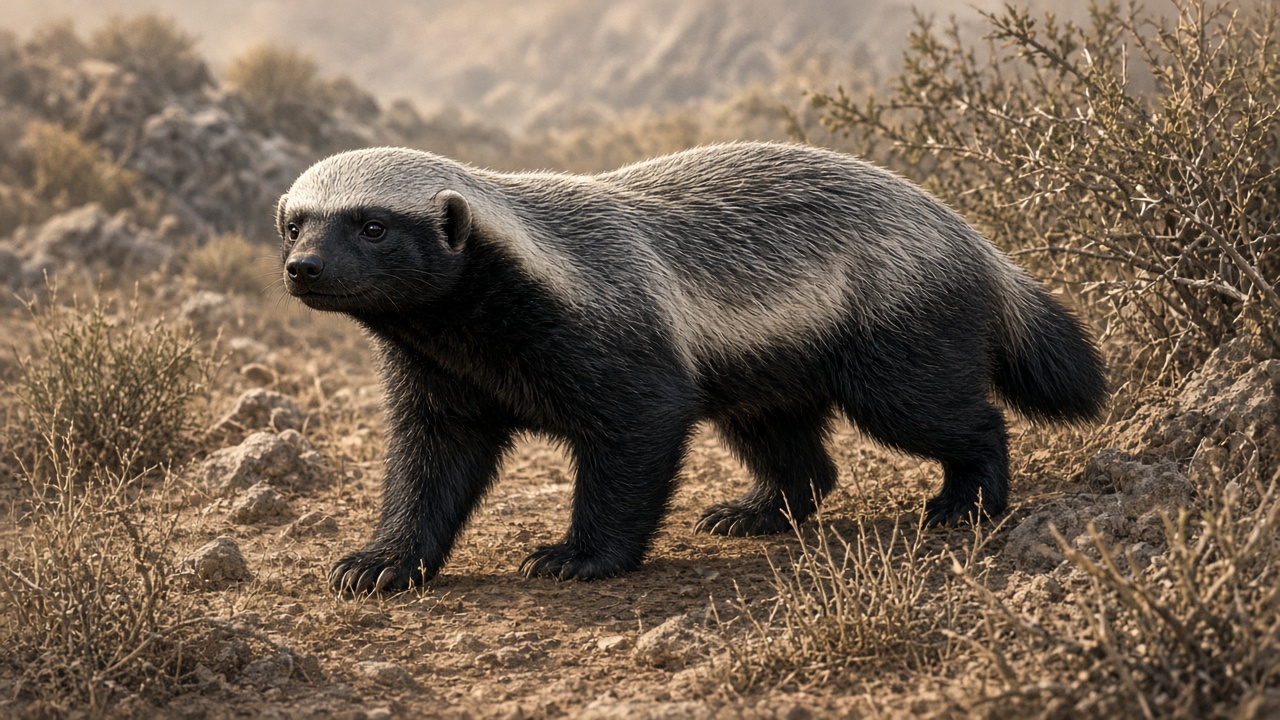
A large, stocky mustelid 60 to 70 cm long and weighing 8 to 12 kg, about 25 cm high at the shoulder, with a large skull, small eyes and a very muscular neck and shoulders. The lower half of the body is black, topped by a grey or bright white mantle running to the base of the tail. The broad forepaws carry large claws; the hind paws are small. Its thick, loose skin lets it twist round and bite an attacker. Males are larger, by about a third in the Kalahari, and older males often have a scarred back.
Solitary and nomadic, it covers about 10 km a day for a female and up to 27 km for a male. An opportunist, it eats mainly rodents, snakes, birds, eggs and frogs, plus fruit, roots and bulbs; it raids beehives for honey and larvae and turns to carrion when needed. In the Kalahari it mates year-round, mostly from September to December; after 50 to 70 days usually a single cub is born, raised by the mother for 12 to 16 months. Lions and leopards kill mainly older animals.
Habitats and range
Its range covers most of sub-Saharan Africa, the Arabian Peninsula and the Middle East, much of India with Nepal and Pakistan, and north to Turkmenistan, Uzbekistan and Kazakhstan; MDD lists it in about sixty countries. It is absent from the driest parts of the Sahara and the Mediterranean coast. It uses tropical forest, thorn forest, open woodland, arid steppe, rocky hills and desert, from sea level to 4,050 m, provided burrows or rock crevices are available.
The countries where the species’ presence is established are shown in the tags on this sheet.
Field signs
It defecates in holes and marks the surroundings of its burrow with urine or anal gland secretions. When threatened it raises its hair, holds the tail erect, makes a loud rattling sound and releases a foul-smelling liquid, often charging. Adults give loud grating calls likened to a high-pitched bark. Beehives broken into, with the larvae eaten, can also betray its presence.
Conservation
For conservation status of Mellivora capensis, consult the current IUCN assessment and cross with national monitoring programmes in countries of documented presence. Never turn a global IUCN category into a local hunting rule. GBIF occurrences help situate distribution but remain effort-biased.
The IUCN lists it as Least Concern despite a declining population: it is not common anywhere. The main threats are traps and poisoned baits set by farmers and beekeepers and killing for traditional medicine; the Botswana population is on CITES Appendix III. It can carry rabies. ADW considers the famous partnership with the greater honeyguide unproven in the wild.
Limits
This sheet on the Honey Badger publishes no season, quota, hunting method or fee: those rules differ between countries and territories and must be checked in official texts. Being described here does not mean a species may be hunted.
Local densities and management plans are not covered here: they are a matter for the managers of each area.
Sources
Sources consulted for this sheet:
- IUCN Red List — species search (consulted 2026-11-02)
- ASM Mammal Diversity Database — Mellivora capensis (consulted 2026-11-02)
- GBIF — species search (consulted 2026-11-02)
- Animal Diversity Web — Mellivora capensis (honey badger) (consulted 2026-11-04)
Conclusion
In short: use the scientific name Mellivora capensis to cross-check sources, confirm taxonomy and conservation status on the institutional portals listed above, and relate every field sign to the habitat where it was actually found.
Identification
Mellivora capensis
Ratel · preferred
Ratel · preferred
Honey Badger · preferred
Ratel
Classification
Class : Mammalia
Order : Carnivora
Family : Mustelidae
Genus : Mellivora
Conservation
IUCN : LC
CITES : —
iucn · LC (global)
Habitat
Frequently asked questions
How do I recognise Honey Badger?
Use Mellivora capensis as the scientific anchor. A large, stocky mustelid 60 to 70 cm long and weighing 8 to 12 kg, about 25 cm high at the shoulder, with a large skull, small eyes and a very muscular neck and shoulders. The lower half of the body is black, topped by a grey or bright white mantle running to the base of the tail...
Where does Honey Badger typically live?
Its range covers most of sub-Saharan Africa, the Arabian Peninsula and the Middle East, much of India with Nepal and Pakistan, and north to Turkmenistan, Uzbekistan and Kazakhstan; MDD lists it in about sixty countries. It is absent from the driest parts of the Sahara and the Mediterranean coast. It uses tropical forest, thorn forest, open woodland, arid ste...
What field signs help confirm Honey Badger?
It defecates in holes and marks the surroundings of its burrow with urine or anal gland secretions. When threatened it raises its hair, holds the tail erect, makes a loud rattling sound and releases a foul-smelling liquid, often charging. Adults give loud grating calls likened to a high-pitched bark. Beehives broken into, with the larvae eaten, can also betr...