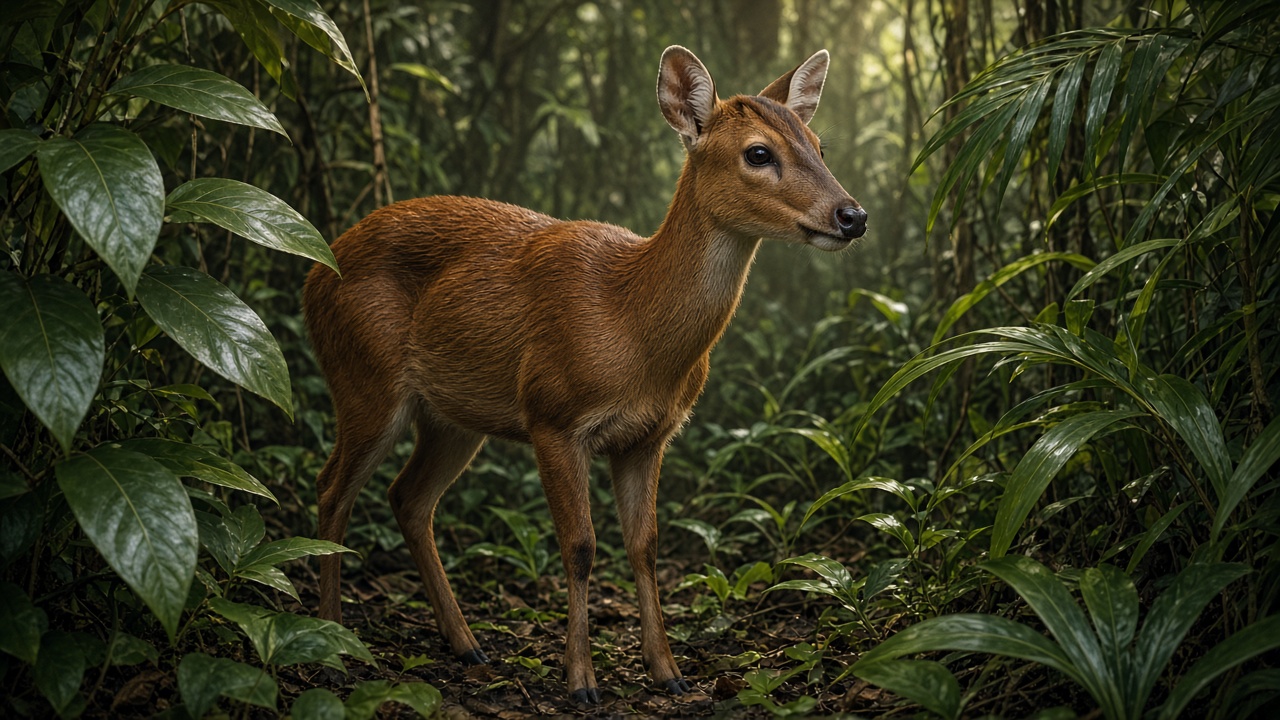
Northwestern Red Brocket
Mazama americanaNorthwestern Red Brocket (Mazama americana): biology, habitats and field signs across its documented range, hunting-context reading.
Seen in: Brazil · Mexico
Overview
Northwestern Red Brocket (Mazama americana) is presented here in a hunting-context reading across its documented range: biology, habitats and field signs useful to observers — without publishing season, quota or authorisation.
Classification: order Artiodactyla, family Cervidae, genus Mazama. Common names: Northwestern Red Brocket in English, Daguet rouge in French, Corzuela roja in Spanish.
Identification
The red brocket is the largest of the Mazama brocket deer: 103 to 146 cm long, 65 to 80 cm at the shoulder, with an 8 to 15 cm tail and a weight of 20 to 55 kg. The head and neck are light greyish-brown and the rest of the body reddish-brown to chestnut red; the inner thighs, throat, tail and inner ears are white. Fawns are born with white spots. Males are larger and carry simple spike antlers. These ADW measurements refer to the species in the broad sense, before recent taxonomic revisions.
It eats mainly fruit, with some leaves and fibrous material; in the wet season, when fruit is scarce, fungi may dominate, and as a last resort it eats stems, bark, petioles and animal matter. Active by day and by night, it is usually seen alone. In the north-eastern Peruvian Amazon, conception occurs in every month except September and October; gestation lasts 222 to 228 days, and the fawn, hidden by its mother, is weaned at about six months. Pumas and jaguars are its predators, and it disperses seeds in the Amazon forest.
Habitats and range
As currently defined (MDD), it occupies northern South America: Colombia, Venezuela, Trinidad and Tobago, Guyana, Suriname, French Guiana, Ecuador, Peru, Bolivia and Brazil. It lives in dense tropical forest with a closed canopy, often near marshes, swamps and streams with thick cover; its small size helps it move through water and dense vegetation unnoticed. At night it comes out to forage along forest edges, in farm fields and in gardens.
The countries where the species’ presence is established are shown in the tags on this sheet.
Field signs
Very secretive, it is hard to observe. When spotted by a predator or alerted by a sound, it freezes; when chased, it alternates leaps through the vegetation with freezing to confuse its pursuer, or swims across a river, being an excellent swimmer. Its reddish coat blends into the undergrowth. Encounters are most likely at night along forest edges or field margins, and it occasionally damages crops.
Conservation
For conservation status of Mazama americana, consult the current IUCN assessment and cross with national monitoring programmes in countries of documented presence. Never turn a global IUCN category into a local hunting rule. GBIF occurrences help situate distribution but remain effort-biased.
MDD shows it as Not Evaluated under its current definition; ADW gave Data Deficient for the species in the broad sense. According to MDD, Mazama americana formerly included M. rufa and M. zetta, now separate species, and the name jucunda now applies to the former species “bororo”; the forms gualea, trinitatis, whitelyi and zamora remain included. TaxRef lists it as native to French Guiana.
Limits
This sheet on the Northwestern Red Brocket publishes no season, quota, hunting method or fee: those rules differ between countries and territories and must be checked in official texts. Being described here does not mean a species may be hunted.
Local densities and management plans are not covered here: they are a matter for the managers of each area.
Sources
Sources consulted for this sheet:
- IUCN Red List — species search (consulted 2026-11-02)
- ASM Mammal Diversity Database — Mazama americana (consulted 2026-11-02)
- GBIF — species search (consulted 2026-11-02)
- Animal Diversity Web — Mazama americana (red brocket) (consulted 2026-11-04)
- TaxRef (MNHN) — Mazama americana, noms vernaculaires et statut en Guyane (consulted 2026-11-04)
Conclusion
In short: use the scientific name Mazama americana to cross-check sources, confirm taxonomy and conservation status on the institutional portals listed above, and relate every field sign to the habitat where it was actually found.
Identification
Mazama americana
Northwestern Red Brocket · preferred
Red Brocket
Common Red Brocket
Classification
Class : Mammalia
Order : Artiodactyla
Family : Cervidae
Genus : Mazama
Conservation
IUCN : DD
CITES : —
iucn · DD (global)
Frequently asked questions
How do I recognise Northwestern Red Brocket?
Use Mazama americana as the scientific anchor. The red brocket is the largest of the Mazama brocket deer: 103 to 146 cm long, 65 to 80 cm at the shoulder, with an 8 to 15 cm tail and a weight of 20 to 55 kg. The head and neck are light greyish-brown and the rest of the body reddish-brown to chestnut red; the inner thighs, thr...
Where does Northwestern Red Brocket typically live?
As currently defined (MDD), it occupies northern South America: Colombia, Venezuela, Trinidad and Tobago, Guyana, Suriname, French Guiana, Ecuador, Peru, Bolivia and Brazil. It lives in dense tropical forest with a closed canopy, often near marshes, swamps and streams with thick cover; its small size helps it move through water and dense vegetation unnoticed...
What field signs help confirm Northwestern Red Brocket?
Very secretive, it is hard to observe. When spotted by a predator or alerted by a sound, it freezes; when chased, it alternates leaps through the vegetation with freezing to confuse its pursuer, or swims across a river, being an excellent swimmer. Its reddish coat blends into the undergrowth. Encounters are most likely at night along forest edges or field ma...