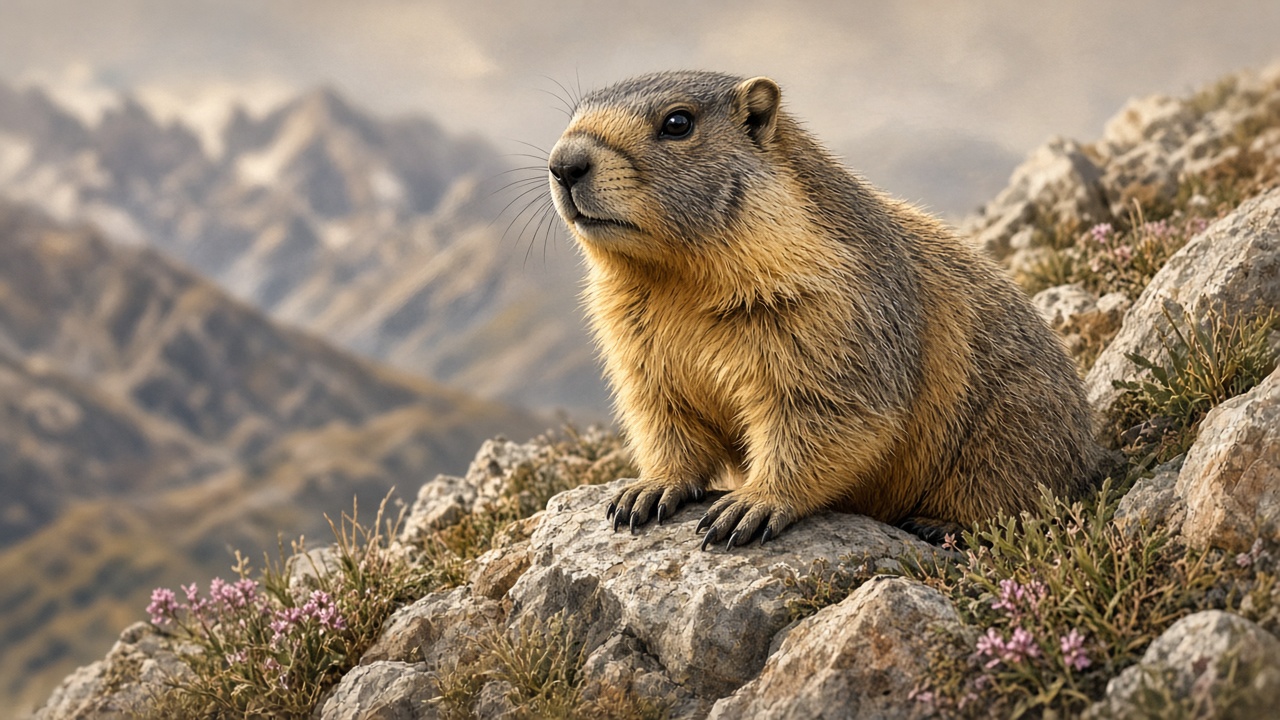
Yellow-bellied Marmot
Marmota flaviventrisYellow-bellied Marmot (Marmota flaviventris): ecology sheet across its documented range — natural history and habitats, without hunting framing.
Seen in: United States
Overview
Yellow-bellied Marmot (Marmota flaviventris) is an ecology sheet across its documented range: natural history and habitats, without any hunting framing.
Classification: order Rodentia, family Sciuridae, genus Marmota. Common names: Yellow-bellied Marmot in English, Marmotte à ventre jaune in French, Marmota de vientre amarillo in Spanish.
Identification
A small to medium-sized marmot with a robust body and a short, broad head: 470 to 700 mm long, including a 130 to 220 mm tail. Males weigh 2.95 to 5.22 kg (3.9 kg on average) and females 1.59 to 3.57 kg (2.8 kg). The coat is yellow-brown to tawny, with buffy yellowish patches on the sides of the neck, white spots between the eyes and a yellow to orange-russet belly that gives the species its name. Melanistic animals are common in the southern Rockies. Animals from low, arid areas are smaller.
Diurnal, it emerges soon after sunrise, grooms and sunbathes, forages by mid-morning and again in late afternoon. A selective herbivore, it eats grasses, flowers and forbs, and large numbers of seeds in late summer. It hibernates for about eight months, from early September to May. Polygynous, it lives mainly in colonies organised as harems. Breeding takes place within two weeks of emerging, in May–June: 3 to 8 young (4.32 on average) after about 30 days. Coyotes, American badgers, martens, black bears and golden eagles prey on it.
Habitats and range
It ranges across the western United States and Canada, from south-central British Columbia and Alberta to the Sierra Nevada; MDD lists it in thirteen states, from Washington to New Mexico. It lives in fairly warm, dry habitats: semi-desert, forest openings and the alpine zone, most often around 2,000 m and higher in the south (only above 2,000 m in California’s White Mountains). It settles on rocky slopes or outcrops within meadows.
The countries where the species’ presence is established are shown in the tags on this sheet.
Field signs
Burrows open under rocks or outcrops that double as lookout and sunning posts; the entrance goes down about 0.6 m and the tunnel runs 3.8 to 4.4 m into the hillside. Animals spend much time sunning with the head up. Calls include a whistle, an undulating scream and a threatening tooth chatter; territorial males flag their tails.
Conservation
For conservation status of Marmota flaviventris, consult the current IUCN assessment and cross with national monitoring programmes in countries of documented presence. Never turn a global IUCN category into a local hunting rule. GBIF occurrences help situate distribution but remain effort-biased.
The IUCN lists it as Least Concern, with no major long-term threats. It carries plague (Yersinia pestis), which has hit populations in California; direct contact carries a rare risk of infection for people. MDD notes that some authors spell the name flaviventer, following the original spelling, but keeps flaviventris as the prevailing usage. The hoary marmot may limit its presence at high elevations.
Limits
This sheet on the Yellow-bellied Marmot covers biology and ecology only; it publishes no hunting season, quota or authorisation.
Local densities and management plans are not covered here: they are a matter for the managers of each area.
Sources
Sources consulted for this sheet:
- IUCN Red List — species search (consulted 2026-11-02)
- ASM Mammal Diversity Database — Marmota flaviventris (consulted 2026-11-02)
- GBIF — species search (consulted 2026-11-02)
- Animal Diversity Web — Marmota flaviventris (yellow-bellied marmot) (consulted 2026-11-04)
Conclusion
In short: use the scientific name Marmota flaviventris to cross-check sources, confirm taxonomy and conservation status on the institutional portals listed above, and relate every field sign to the habitat where it was actually found.
Identification
Marmota flaviventris
Marmotte à ventre jaune · preferred
Marmota de vientre amarillo · preferred
Yellow-bellied Marmot · preferred
Marmota flaviventer
Classification
Class : Mammalia
Order : Rodentia
Family : Sciuridae
Genus : Marmota
Conservation
IUCN : LC
CITES : —
iucn · LC (global)
Habitat
Frequently asked questions
How do I recognise Yellow-bellied Marmot?
Use Marmota flaviventris as the scientific anchor. A small to medium-sized marmot with a robust body and a short, broad head: 470 to 700 mm long, including a 130 to 220 mm tail. Males weigh 2.95 to 5.22 kg (3.9 kg on average) and females 1.59 to 3.57 kg (2.8 kg). The coat is yellow-brown to tawny, with buffy yellowish patches on...
Where does Yellow-bellied Marmot typically live?
It ranges across the western United States and Canada, from south-central British Columbia and Alberta to the Sierra Nevada; MDD lists it in thirteen states, from Washington to New Mexico. It lives in fairly warm, dry habitats: semi-desert, forest openings and the alpine zone, most often around 2,000 m and higher in the south (only above 2,000 m in Californi...
What field signs help confirm Yellow-bellied Marmot?
Burrows open under rocks or outcrops that double as lookout and sunning posts; the entrance goes down about 0.6 m and the tunnel runs 3.8 to 4.4 m into the hillside. Animals spend much time sunning with the head up. Calls include a whistle, an undulating scream and a threatening tooth chatter; territorial males flag their tails.