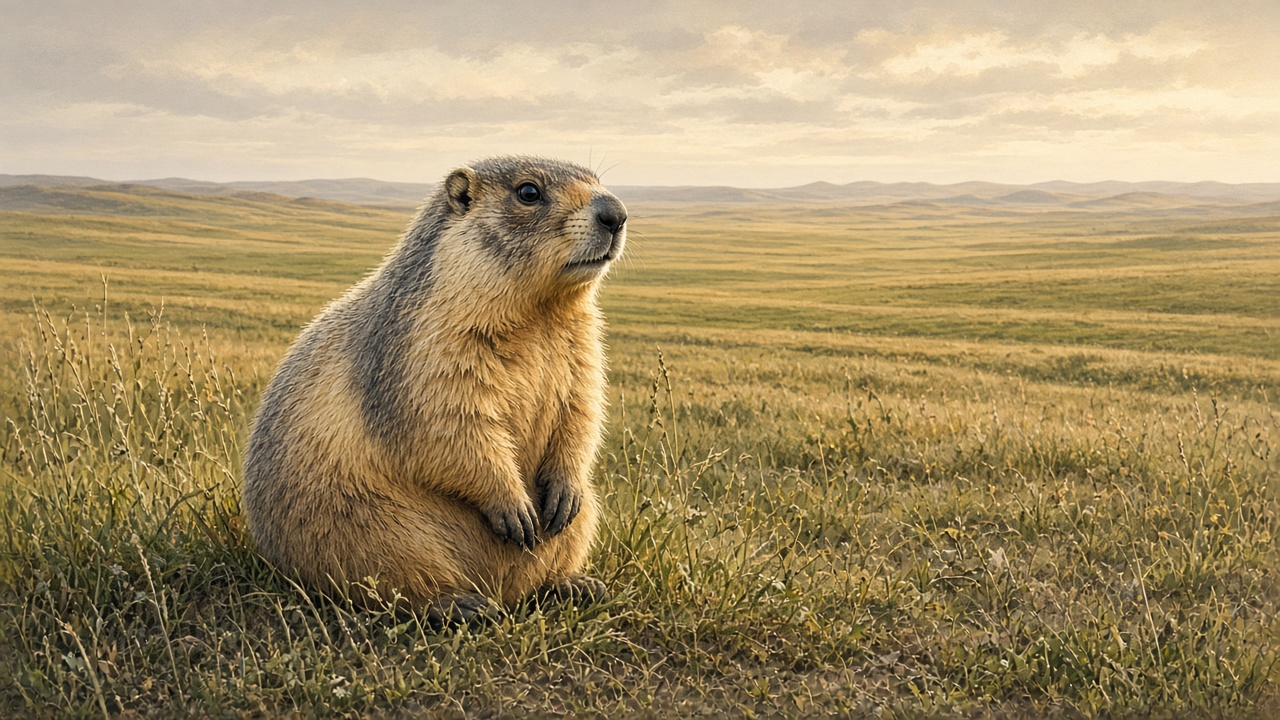
Bobak Marmot
Marmota bobakNo solid country presence documented yet.
Bobak Marmot (Marmota bobak): ecology sheet across its documented range — natural history and habitats, without hunting framing.
Overview
Bobak Marmot (Marmota bobak) is an ecology sheet across its documented range: natural history and habitats, without any hunting framing.
Classification: order Rodentia, family Sciuridae, genus Marmota. Common names: Bobak Marmot in English, Marmotte bobak in French, Marmota bobac in Spanish.
Identification
A large steppe marmot, often likened to an oversized prairie dog: round belly, stubby legs and a short tail, 490 to 575 mm long and about 7.3 kg on average; males are somewhat larger. The short, dense coat is straw-coloured to rusty with dark brown tips in autumn, more concentrated between the eyes so the top of the head looks darker; belly, chin and throat are a darker rust and the tail tip dark brown. In spring the worn, sun-scorched fur looks paler.
Highly gregarious, it lives in families of 2 to 5 adults and 2 to 6 young, with up to 15 families per square kilometre. Active mainly in the morning and at dusk, it spends 12 to 16 hours above ground at the height of the season and hibernates for about 5.5 months. It grazes mainly on wild steppe grasses, chicory, clover and bindweed, occasionally on gardens and sunflowers. Mating takes place in the burrow at the end of hibernation or shortly after; after 40 to 42 days, 4 to 6 young are born. Maturity comes at 3 years. Stray dogs, foxes and large eagles are its main predators.
Habitats and range
MDD lists it for Kazakhstan, Russia and Ukraine. ADW describes it mostly in scattered colonies along the Don and Donets rivers and in the middle and southern Urals, on the steppes of northern Kazakhstan, only a fraction of its former range. It lives on open rolling steppe and grassland, low slopes and land between rivers rich in forbs and feather grasses, as well as field edges, hard ground and fallow land in partly ploughed steppe.
The countries where the species’ presence is established are shown in the tags on this sheet.
Field signs
Easy to spot while grazing in the open, it is found through colonies of burrows, sometimes dug into dirt roads by young animals drawn by the hard soil and roadside weeds. One or two sentinels, usually females, sit upright with forepaws against the belly and give an alarm call when a predator approaches. Freshly ploughed ground is avoided.
Conservation
For conservation status of Marmota bobak, consult the current IUCN assessment and cross with national monitoring programmes in countries of documented presence. Never turn a global IUCN category into a local hunting rule. GBIF occurrences help situate distribution but remain effort-biased.
The IUCN lists it as Least Concern. ADW nonetheless notes that extensive trapping for fur and overexploitation have greatly reduced its populations across its range, and that ploughing of the steppe pushes colonies onto fallow land. Its burrows aerate the soil, and abandoned colonies provide dens for other ground-dwelling mammals.
Limits
This sheet on the Bobak Marmot covers biology and ecology only; it publishes no hunting season, quota or authorisation.
Local densities and management plans are not covered here: they are a matter for the managers of each area.
Sources
Sources consulted for this sheet:
- IUCN Red List — species search (consulted 2026-11-02)
- ASM Mammal Diversity Database — Marmota bobak (consulted 2026-11-02)
- GBIF — species search (consulted 2026-11-02)
- Animal Diversity Web — Marmota bobak (Bobak marmot) (consulted 2026-11-04)
Conclusion
In short: use the scientific name Marmota bobak to cross-check sources, confirm taxonomy and conservation status on the institutional portals listed above, and relate every field sign to the habitat where it was actually found.
Identification
Marmota bobak
Marmotte bobak · preferred
Marmota bobac · preferred
Bobak Marmot · preferred
Classification
Class : Mammalia
Order : Rodentia
Family : Sciuridae
Genus : Marmota
Conservation
IUCN : LC
CITES : —
iucn · LC (global)
Habitat
Frequently asked questions
How do I recognise Bobak Marmot?
Use Marmota bobak as the scientific anchor. A large steppe marmot, often likened to an oversized prairie dog: round belly, stubby legs and a short tail, 490 to 575 mm long and about 7.3 kg on average; males are somewhat larger. The short, dense coat is straw-coloured to rusty with dark brown tips in autumn, more concentrat...
Where does Bobak Marmot typically live?
MDD lists it for Kazakhstan, Russia and Ukraine. ADW describes it mostly in scattered colonies along the Don and Donets rivers and in the middle and southern Urals, on the steppes of northern Kazakhstan, only a fraction of its former range. It lives on open rolling steppe and grassland, low slopes and land between rivers rich in forbs and feather grasses, as...
What field signs help confirm Bobak Marmot?
Easy to spot while grazing in the open, it is found through colonies of burrows, sometimes dug into dirt roads by young animals drawn by the hard soil and roadside weeds. One or two sentinels, usually females, sit upright with forepaws against the belly and give an alarm call when a predator approaches. Freshly ploughed ground is avoided.