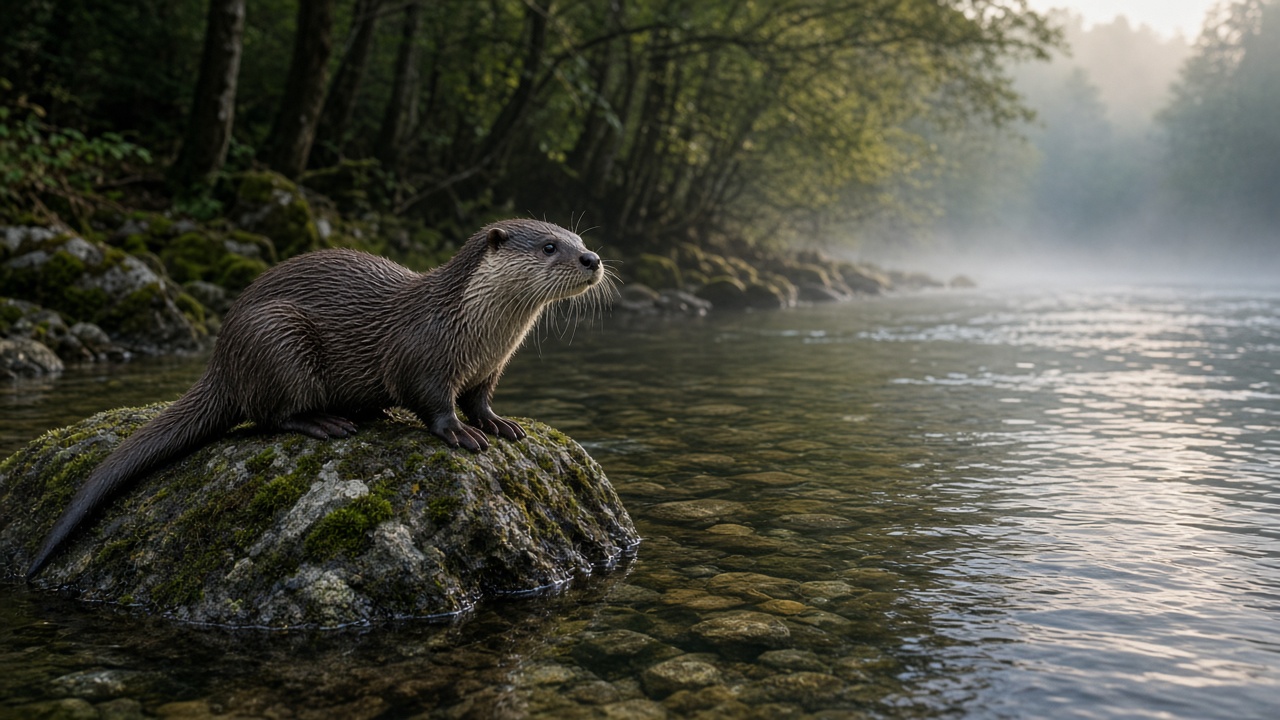
Eurasian Otter
Lutra lutraEurasian Otter (Lutra lutra): coexistence sheet across its documented range — presence, biology and prudence, without an invented hunting status.
Seen in: Austria · Belgium · Bulgaria · Croatia · Czechia
Overview
Eurasian Otter (Lutra lutra) is a coexistence sheet across its documented range: presence, biology and prudence — not a hunting status claim.
Classification: order Carnivora, family Mustelidae, genus Lutra. Common names: Eurasian Otter in English, Loutre d'Europe in French, Nutria euroasiática in Spanish.
Identification
The Eurasian otter measures 102 to 138 cm overall, of which 57 to 70 cm is body and 35 to 40 cm tail, and weighs 4 to 11 kg, 6.75 kg on average. Its long whiskers act as sense organs underwater, tracking the movements of fish and other prey. Paired scent glands at the base of the tail give off a heavy, musky smell, which the otter also works into its fur. It can stay submerged for up to two minutes. Cubs weigh 99 to 122 g at birth.
Solitary, it forms only temporary pairs or mother-and-young groups, sometimes loose groups of up to six animals. Mostly active at dusk and at night, it becomes diurnal in some places such as the Scottish isles, where it forages at sea and then seeks freshwater pools to wash the salt from its coat. It eats about 1 kg a day: fish, crustaceans, clams, amphibians, small mammals, birds, eggs, insects and worms. Breeding can occur year-round, peaking in February–March and July: 2 or 3 cubs after 60 to 70 days, staying with the mother for up to 14 months.
Habitats and range
It has one of the widest ranges of any Palearctic mammal, from Ireland to China and down to Southeast Asia, covering most of Eurasia south of the tundra line as well as North Africa; MDD lists it in France, Spain, Portugal, Morocco and Algeria among many others. It forages in rivers, lakes, streams, freshwater and peat swamp forests, rice fields, sea coasts and fjords, and rests on land in earth tunnels, under tree roots, in boulder piles, shrubs or banks.
The countries where the species’ presence is established are shown in the tags on this sheet.
Field signs
Each otter has fixed spots for getting in and out of the water, rolling, sunbathing and sliding on “otter slides”. It scent-marks vegetation and logs with its musky secretion, signalling territory, identity and sexual state. It may be seen sliding on its belly down mudbanks or snowdrifts and playing in the water. Calls include short, shrill whistles, yelps, whimpers and high-pitched screams of distress.
Conservation
For conservation status of Lutra lutra, consult the current IUCN assessment, then cross with French monitoring programmes when they exist (OFB portal and related publications). Never turn a global IUCN category into a departmental hunting rule. GBIF occurrences help situate documented distribution but remain effort-biased.
The IUCN lists it as Near Threatened. It is declining in many countries and its status is unknown in others; documented threats are pollution, poaching, habitat loss, accidental trapping and road kill. It has made a spectacular comeback in the British Isles since the 1980s as pollution fell. Birds of prey, crocodiles and dogs are listed among its predators. According to MDD, the Japanese otter (L. nippon), sometimes included, is a distinct species.
Limits
This sheet on the Eurasian Otter covers presence and biology. A species being present in a country does not mean it may be hunted, and no season or quota is published here.
Local densities and management plans are not covered here: they are a matter for the managers of each area.
Sources
Sources consulted for this sheet:
- IUCN Red List — species search (consulted 2026-11-01)
- ASM Mammal Diversity Database — Lutra lutra (consulted 2026-11-01)
- GBIF — species search (consulted 2026-11-01)
- Animal Diversity Web — Lutra lutra (European otter) (consulted 2026-11-04)
- IUCN SSC Otter Specialist Group — Lutra lutra (consulted 2026-11-04)
Conclusion
In short: use the scientific name Lutra lutra to cross-check sources, confirm taxonomy and conservation status on the institutional portals listed above, and relate every field sign to the habitat where it was actually found.
Identification
Lutra lutra
Loutre d'Europe · preferred
Nutria euroasiática · preferred
Eurasian Otter · preferred
European Otter
Classification
Class : Mammalia
Order : Carnivora
Family : Mustelidae
Genus : Lutra
Conservation
IUCN : NT
CITES : —
iucn · NT (global)
Habitat
Frequently asked questions
How do I recognise Eurasian Otter?
Use Lutra lutra as the scientific anchor. The Eurasian otter measures 102 to 138 cm overall, of which 57 to 70 cm is body and 35 to 40 cm tail, and weighs 4 to 11 kg, 6.75 kg on average. Its long whiskers act as sense organs underwater, tracking the movements of fish and other prey. Paired scent glands at the base of the...
Where does Eurasian Otter typically live?
It has one of the widest ranges of any Palearctic mammal, from Ireland to China and down to Southeast Asia, covering most of Eurasia south of the tundra line as well as North Africa; MDD lists it in France, Spain, Portugal, Morocco and Algeria among many others. It forages in rivers, lakes, streams, freshwater and peat swamp forests, rice fields, sea coasts...
What field signs help confirm Eurasian Otter?
Each otter has fixed spots for getting in and out of the water, rolling, sunbathing and sliding on “otter slides”. It scent-marks vegetation and logs with its musky secretion, signalling territory, identity and sexual state. It may be seen sliding on its belly down mudbanks or snowdrifts and playing in the water. Calls include short, shrill whistles, yelps,...