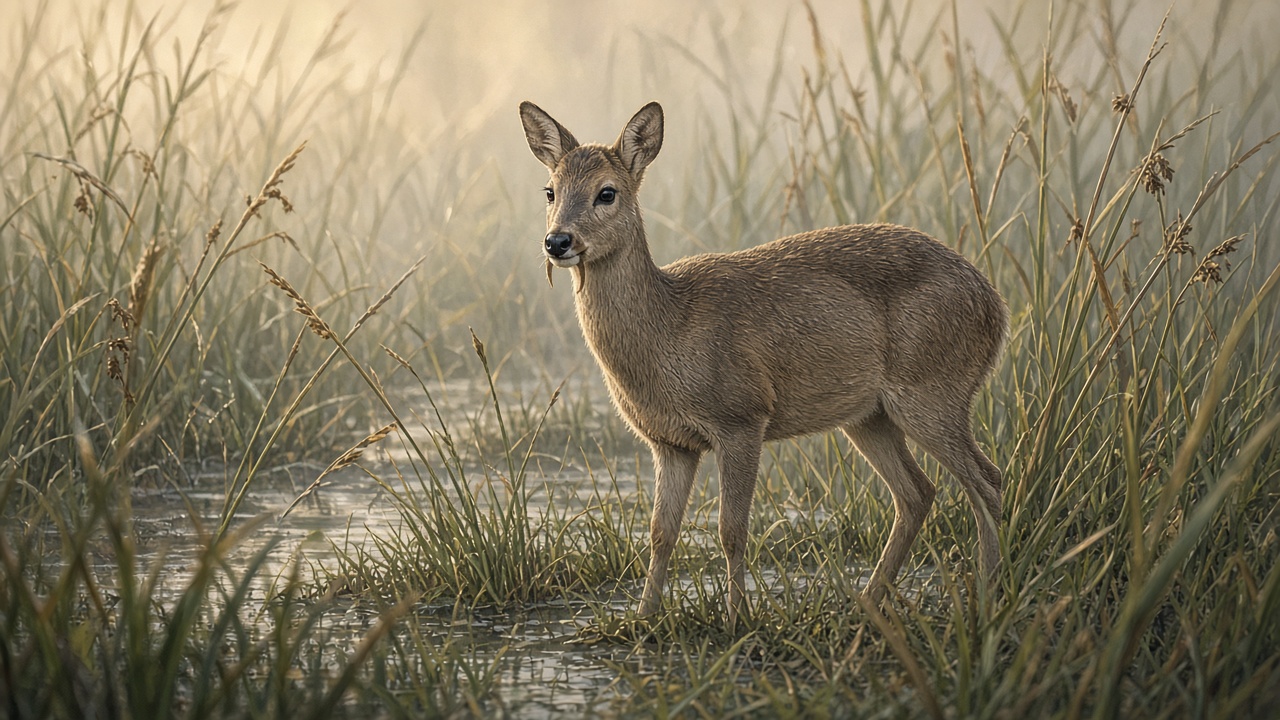
Water Deer
Hydropotes inermisWater Deer (Hydropotes inermis): biology, habitats and field signs across its documented range, hunting-context reading.
Seen in: United Kingdom
Overview
Water Deer (Hydropotes inermis) is presented here in a hunting-context reading across its documented range: biology, habitats and field signs useful to observers — without publishing season, quota or authorisation.
Classification: order Artiodactyla, family Cervidae, genus Hydropotes. Common names: Water Deer in English, Hydropote in French, Ciervo de agua chino in Spanish.
Identification
A small deer 77.5 to 100 cm long with a short tail (6 to 7.5 cm), the water deer weighs 12 to 18.5 kg. Its thick, coarse coat, longest on the flanks and rump (up to 40 mm in winter), is yellowish-brown finely flecked with black, with a grey and reddish-brown upper face, whitish chin and throat and white underparts. Neither sex has antlers: males are recognised by their slightly curved upper canine tusks, protruding up to 52 mm from the jaw and set off by a dark spot on the lip; females’ canines are only about 5 mm.
Highly selective in its diet, it chooses low-fibre foods: herbs, forbs and young sweet grasses, but also reeds, vegetables and beets. It lives alone or in pairs; bucks defend territories against all rivals and tolerate only one or a few does. Fights are fought with the canines, aimed at the neck and shoulders; the loser submits by laying its head and neck flat on the ground. In China the rut runs from November to January and most births occur in late May and June; after 170 to 210 days, usually two or three spotted fawns are born and stay hidden for the first weeks. Males mature at 5–6 months, females at 7–8 months.
Habitats and range
MDD gives it in China (formerly from Liaoning to Guangxi, including the lower Yangtze Basin) and Korea, and records it as introduced to England and France; in England, animals escaped from Woburn Park founded a feral population. It lives in tall reed beds, riverside rushes, tall grass on mountains and farmland, swamps and open grassland, preferring drier ground. It can swim several kilometres between islets.
The countries where the species’ presence is established are shown in the tags on this sheet.
Field signs
When disturbed it humps its back and flees in a series of leaps, giving a brief, shrill alarm bark. Bucks mark by rubbing their foreheads on tree trunks, paw the ground and leave dung piles that also act as scent marks. After fields are cut, it may be found lying in the furrows. The buck’s tusks can be seen at close range.
Conservation
For conservation status of Hydropotes inermis, consult the current IUCN assessment and cross with national monitoring programmes in countries of documented presence. Never turn a global IUCN category into a local hunting rule. GBIF occurrences help situate distribution but remain effort-biased.
The IUCN lists it as Vulnerable. ADW reports heavy exploitation in the wild, notably for colostrum used in folk medicine, and an estimate of only 10,000 animals left in the wild in China (Butzler, 1990); it also damages crops and forestry plantations. MDD lists affinis, argyropus (Korea) and kreyenbergi as synonyms.
Limits
This sheet on the Water Deer publishes no season, quota, hunting method or fee: those rules differ between countries and territories and must be checked in official texts. Being described here does not mean a species may be hunted.
Local densities and management plans are not covered here: they are a matter for the managers of each area.
Sources
Sources consulted for this sheet:
- IUCN Red List — species search (consulted 2026-11-02)
- ASM Mammal Diversity Database — Hydropotes inermis (consulted 2026-11-02)
- GBIF — species search (consulted 2026-11-02)
- Animal Diversity Web — Hydropotes inermis (Chinese water deer) (consulted 2026-11-04)
Conclusion
In short: use the scientific name Hydropotes inermis to cross-check sources, confirm taxonomy and conservation status on the institutional portals listed above, and relate every field sign to the habitat where it was actually found.
Identification
Hydropotes inermis
Hydropote · preferred
Ciervo de agua chino · preferred
Water Deer · preferred
Chinese Water Deer
Vampire Deer
Classification
Class : Mammalia
Order : Artiodactyla
Family : Cervidae
Genus : Hydropotes
Conservation
IUCN : VU
CITES : —
iucn · VU (global)
Habitat
Frequently asked questions
How do I recognise Water Deer?
Use Hydropotes inermis as the scientific anchor. A small deer 77.5 to 100 cm long with a short tail (6 to 7.5 cm), the water deer weighs 12 to 18.5 kg. Its thick, coarse coat, longest on the flanks and rump (up to 40 mm in winter), is yellowish-brown finely flecked with black, with a grey and reddish-brown upper face, whitish c...
Where does Water Deer typically live?
MDD gives it in China (formerly from Liaoning to Guangxi, including the lower Yangtze Basin) and Korea, and records it as introduced to England and France; in England, animals escaped from Woburn Park founded a feral population. It lives in tall reed beds, riverside rushes, tall grass on mountains and farmland, swamps and open grassland, preferring drier gro...
What field signs help confirm Water Deer?
When disturbed it humps its back and flees in a series of leaps, giving a brief, shrill alarm bark. Bucks mark by rubbing their foreheads on tree trunks, paw the ground and leave dung piles that also act as scent marks. After fields are cut, it may be found lying in the furrows. The buck’s tusks can be seen at close range.