Hunting landscapes
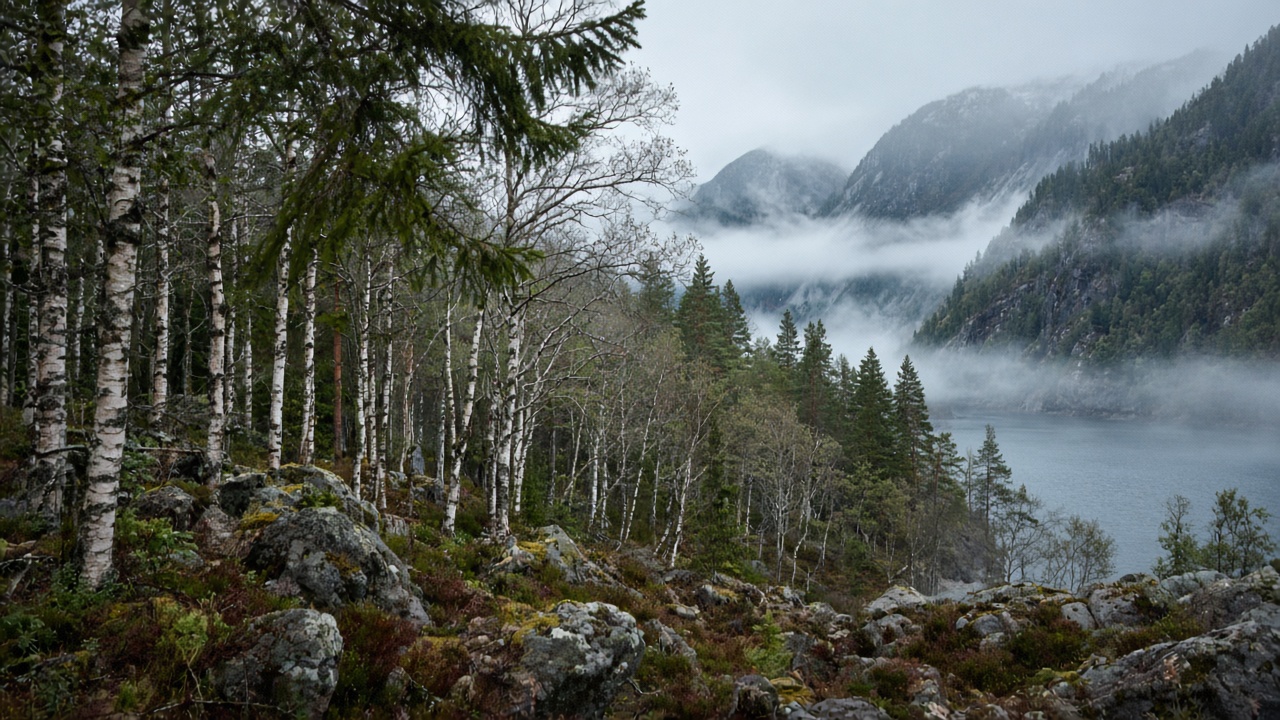
Norway offers boreal forest in the east, mountains and high plateaus such as Hardangervidda, and a long coastline. Big game hunting takes place mostly in forest and on plateaus, ptarmigan hunting in the mountains.
Key species
- Moose (Alces alces)
- Wild reindeer (Rangifer tarandus tarandus)
- Willow ptarmigan (Lagopus lagopus)
Main hunting methods
- moose hunting with a free-running dog (elgjakt med los hund)
- ptarmigan hunting with pointing dogs (rypejakt)
Wildlife health
Chronic wasting disease (CWD) was discovered in 2016 in wild reindeer at Nordfjella, a first in Europe. Drastic measures followed, and hunters supply samples from harvested deer for surveillance.
Who hunts in Norway
The hunter register (Jegerregisteret) listed 558,527 people in 2025-2026, according to Statistics Norway (SSB, published 10 April 2026), 16.9% of them women. Only a minority hunt in any given year: 184,747 hunters paid the hunting fee (jegeravgift) that season, roughly a third of those registered, and 130,300 hunted at least once in 2023-2024, according to the same source. The fee is required for the whole hunting year, which runs from 1 April to 31 March, but it does not give the right to hunt in any particular area: the right to hunt on a given piece of land is obtained separately. The Ministry of Agriculture and Food also notes that selling hunting on big and small game is a source of income for many landowners (regjeringen.no).
For new hunters, the entry point is the hunter exam (jegerprøve): 12,171 people passed it in 2025-2026, 11.2% more than a year earlier, 25.8% of them women. Foreign hunters are a small group: about 1,550 paid the fee in 2024-2025, out of 3,900 registered, against 2,100 payers out of 10,300 registered in 2003-2004.
What the 2025-2026 harvest shows
Red deer (hjort) now outnumber moose in the harvest: 50,150 were shot in 2025-2026, 8% fewer than the previous season, which had set the peak at 54,200 (preliminary figures published by SSB on 20 March 2026). Vestland accounts for 24,500, almost half the national total, and the municipality of Sunnfjord leads with 2,370 red deer, ahead of Kvinnherad (1,300).
For moose, the 2025-2026 season gives 26,600 animals, a slight rise after the low of 26,000 in 2023-2024; the peak remains that of 1999-2000, with 39,400. Trysil (629) and Steinkjer (560) are the top two municipalities. Over ten years Nordland is up 15% (4,177 moose) and Troms up 20% (1,854), while the harvest in Østfold and Vestfold has halved. Wild reindeer reach 3,851 animals in 2025 (+17.8%) and roe deer 32,900 in 2022-2023 (−5.1%).
Ptarmigan: a fragile mountain hunt
In the mountains the picture is less favourable. SSB counts 93,340 willow ptarmigan and 47,950 rock ptarmigan shot in 2024-2025, after 119,600 grouse in 2023-2024, which the institute describes as a record low. The number of Norwegians paying the fee fell by 11% in two years, to 171,740 in 2024-2025: SSB sees as a "probable" cause the small ptarmigan stocks, which kept many hunting areas from opening. The fee rose again in 2025-2026 (184,747, +7.6%).
Who decides since 2025
Since 1 January 2025 the Norwegian Agriculture Agency (Landbruksdirektoratet) has taken over management of harvestable species, the conduct of hunting and trapping, the hunter exam and the shooting test. Miljødirektoratet keeps the large predators and still sets the hunting and trapping seasons (announcement of 1 January 2025). At ministry level, Agriculture and Food holds the Wildlife Act, while Climate and Environment decides whether a species may be hunted, where, and over what period. Planning a season therefore means two counters: dates at Miljødirektoratet, practice and exam at Landbruksdirektoratet.
Key figures
| Indicator | Value | Period |
|---|---|---|
| Hunters in the register | 558,527 | 2025-2026 |
| Hunting fee paid | 184,747 (+7.6%) | 2025-2026 |
| Hunters who hunted | 130,300 (−2.8%) | 2023-2024 |
| Hunter exam passed | 12,171 | 2025-2026 |
| Red deer shot | 50,150 (−8%) | 2025-2026, preliminary |
| Moose shot | 26,600 | 2025-2026, preliminary |
| Wild reindeer shot | 3,851 | 2025 |
| Ptarmigan (willow / rock) | 93,340 / 47,950 | 2024-2025 |
| Foreigners who paid the fee | about 1,550 | 2024-2025 |