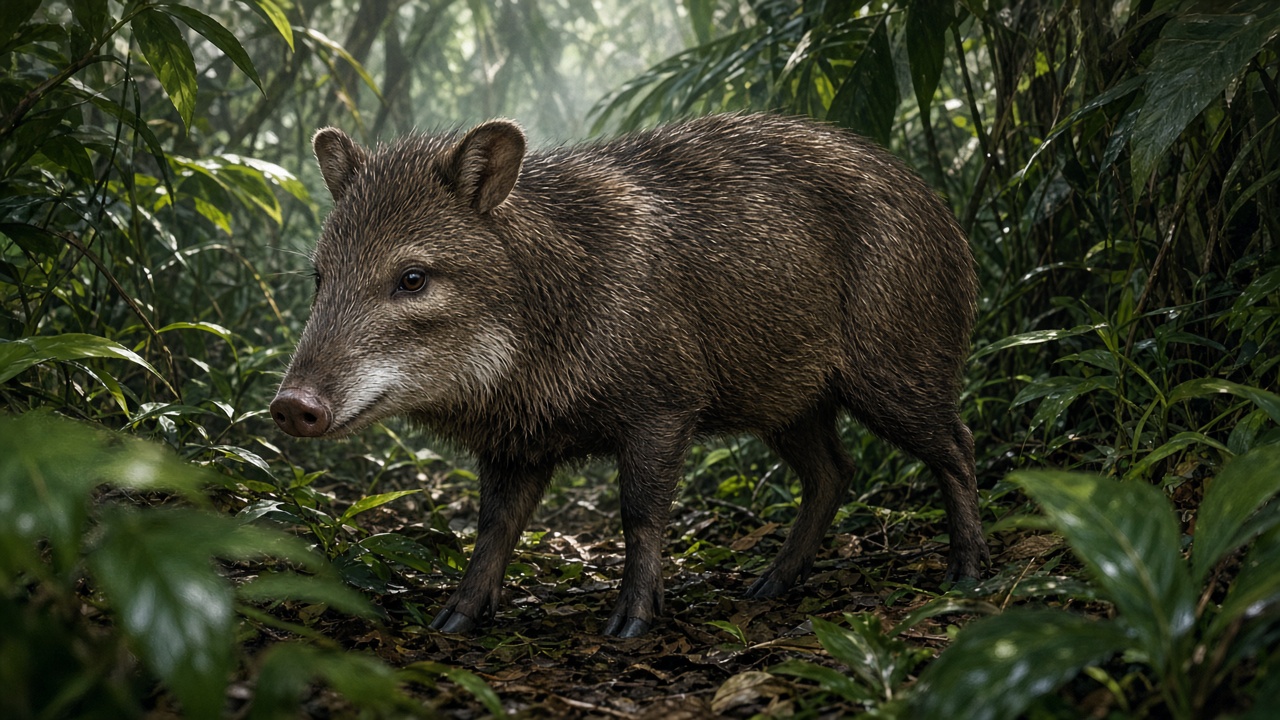
White-lipped Peccary (Tayassu pecari): coexistence sheet across its documented range — presence, biology and prudence, without an invented hunting status.
Seen in: Brazil
Overview
White-lipped Peccary (Tayassu pecari) is a coexistence sheet across its documented range: presence, biology and prudence — not a hunting status claim.
Classification: order Artiodactyla, family Tayassuidae, genus Tayassu. Common names: White-lipped Peccary in English, Pécari à lèvres blanches in French, Pecarí de labios blancos in Spanish.
Identification
A medium-sized peccary with a pig-like body: long snout, thick neck, large head, tiny tail (15 to 55 mm) and thin legs. It measures 75 to 100 cm long and 44 to 57.5 cm at the shoulder, weighing 25 to 40 kg. The coarse coat, covering the whole body, is dark brown to black in adults, with white areas on the pelvic region and the top of the neck. Young have a mix of red, brown, black and cream. The large, sharp canines form a distinct lump under the lips and are longer in males.
An omnivore that eats mostly plant matter, it takes fruit, leaves, roots, seeds, mushrooms, earthworms and insects, and occasionally frogs, snakes, lizards, bird and turtle eggs or carrion. It breeds all year, most often in spring and autumn; after 156 to 162 days of gestation, 1 to 4 young are born, usually twins, which can run within a few hours and follow their mother the next day. Its mixed herds, often dominated by females, protect it from pumas and jaguars.
Habitats and range
According to MDD, it occurs in Mexico (east from Oaxaca and Veracruz) and all of Central America, then in South America in northern Argentina, Bolivia, Brazil, Colombia, western Ecuador, French Guiana, Guyana, Paraguay, Peru, Suriname and Venezuela; it has been introduced to Cuba. ADW describes it in varied habitats, from desert scrub to arid woodland and rainforest, using thickets, limestone caves and large boulders as shelter, rarely far from water.
The countries where the species’ presence is established are shown in the tags on this sheet.
Field signs
Nomadic, it ranges over 60 to 200 km² in herds of 5 to over 200 animals, sometimes up to 2,000. Large, active herds make a constant racket of bellowing, screaming and loud tooth-clacking that carries several hundred metres; small groups stay quiet. A visit lasts a few hours to a couple of days and leaves the ground churned up, and mud wallows along the same routes are used again and again.
Conservation
For conservation status of Tayassu pecari, consult the current IUCN assessment and cross with national monitoring programmes in countries of documented presence. Never turn a global IUCN category into a local hunting rule. GBIF occurrences help situate distribution but remain effort-biased.
MDD gives its IUCN status as Vulnerable (ADW still showed Near Threatened). It has vanished from parts of Mexico and northern Argentina; hunting and deforestation are the threats described, and where it is disappearing only herds of fewer than ten remain. It also raids crops such as maize, sweet potato, cassava, bananas and sugar cane.
Limits
This sheet on the White-lipped Peccary covers presence and biology. A species being present in a country does not mean it may be hunted, and no season or quota is published here.
Local densities and management plans are not covered here: they are a matter for the managers of each area.
Sources
Sources consulted for this sheet:
- IUCN Red List — species search (consulted 2026-11-02)
- ASM Mammal Diversity Database — Tayassu pecari (consulted 2026-11-02)
- GBIF — species search (consulted 2026-11-02)
- Animal Diversity Web — Tayassu pecari (white-lipped peccary) (consulted 2026-11-04)
Conclusion
In short: use the scientific name Tayassu pecari to cross-check sources, confirm taxonomy and conservation status on the institutional portals listed above, and relate every field sign to the habitat where it was actually found.
Identification
Tayassu pecari
White-lipped Peccary · preferred
Pécari à lèvres blanches · preferred
Pecarí de labios blancos · preferred
Classification
Class : Mammalia
Order : Artiodactyla
Family : Tayassuidae
Genus : Tayassu
Conservation
IUCN : VU
CITES : —
iucn · VU (global)
Frequently asked questions
How do I recognise White-lipped Peccary?
Use Tayassu pecari as the scientific anchor. A medium-sized peccary with a pig-like body: long snout, thick neck, large head, tiny tail (15 to 55 mm) and thin legs. It measures 75 to 100 cm long and 44 to 57.5 cm at the shoulder, weighing 25 to 40 kg. The coarse coat, covering the whole body, is dark brown to black in adult...
Where does White-lipped Peccary typically live?
According to MDD, it occurs in Mexico (east from Oaxaca and Veracruz) and all of Central America, then in South America in northern Argentina, Bolivia, Brazil, Colombia, western Ecuador, French Guiana, Guyana, Paraguay, Peru, Suriname and Venezuela; it has been introduced to Cuba. ADW describes it in varied habitats, from desert scrub to arid woodland and ra...
What field signs help confirm White-lipped Peccary?
Nomadic, it ranges over 60 to 200 km² in herds of 5 to over 200 animals, sometimes up to 2,000. Large, active herds make a constant racket of bellowing, screaming and loud tooth-clacking that carries several hundred metres; small groups stay quiet. A visit lasts a few hours to a couple of days and leaves the ground churned up, and mud wallows along the same...