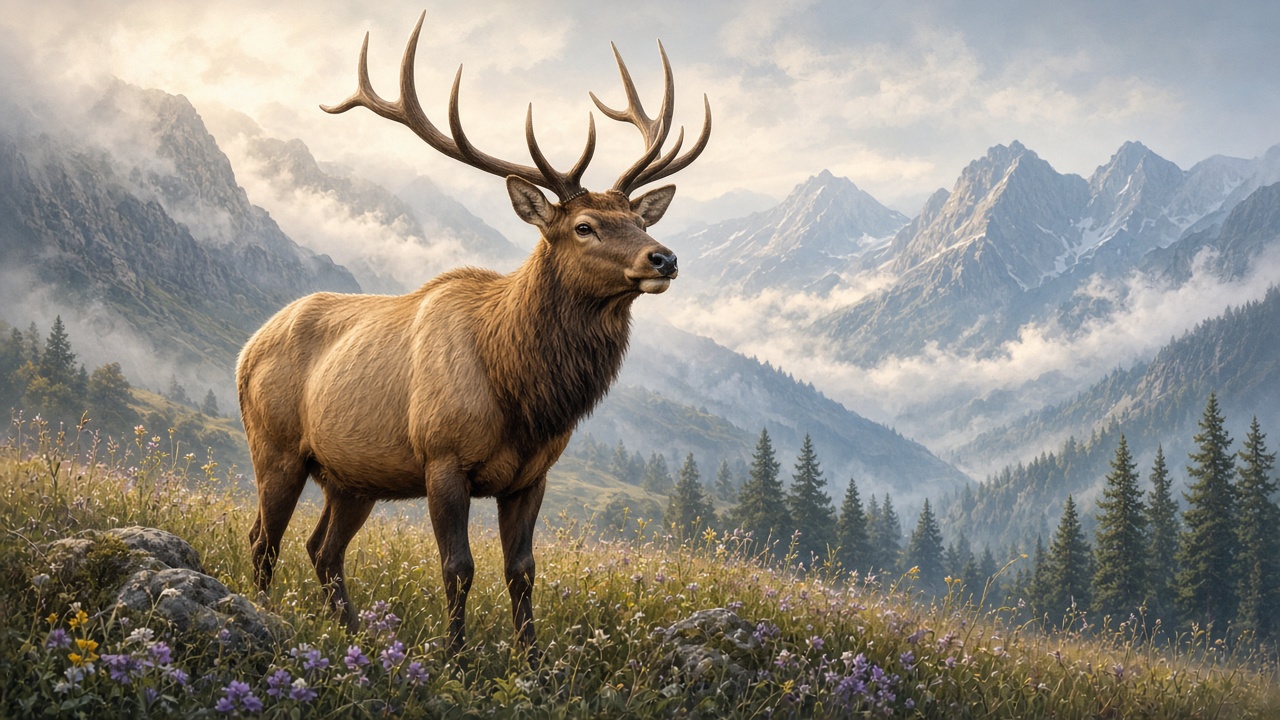
Wapiti
Cervus canadensisWapiti (Cervus canadensis): biology, habitats and field signs across its documented range, hunting-context reading.
Seen in: Argentina · New Zealand · United States
Overview
Wapiti (Cervus canadensis) is presented here in a hunting-context reading across its documented range: biology, habitats and field signs useful to observers — without publishing season, quota or authorisation.
Classification: order Artiodactyla, family Cervidae, genus Cervus. Common names: Wapiti in English, Wapiti in French, Wapití in Spanish.
Identification
The wapiti is one of the largest deer. According to the US National Park Service, bulls weigh about 320 to 450 kg, stand 1.5 m at the shoulder and are 2.4 m long; cows weigh 135 to 225 kg, stand about 1.4 m and are 1.8 m long. Both sexes have a dark brown mane, a light brown body and a white rump; the Shawnee word wapiti means “white deer” or “white-rumped deer”. The coat thickens each winter. Only bulls carry antlers: a healthy mature bull has six tines on each side, antlers 1.4 to 1.5 m long and about 14 kg per pair.
Highly social, it lives in herds of up to a few hundred animals made up of cows, calves and young bulls; older bulls stay alone or in small groups until the rut, from early September to mid-October. Spotted calves are born from late May to late June, usually one of about 14 kg; they join the herd at two weeks and are weaned at two months. It grazes grasses, sedges and forbs and also browses shrubs, aspen bark and conifer needles, mostly in the morning and evening. In Yellowstone it makes up about 85% of winter wolf kills and is also taken by bears and mountain lions.
Habitats and range
MDD gives its range in Asia from Kyrgyzstan and northern Xinjiang east to southern Siberia and northern Mongolia, and in North America in western Canada and the western United States. In the Rocky Mountains it spends summer at high elevation, up to the tundra, and moves down to lower valleys in winter; it is seen in meadows and where meadow meets forest. Its migration tracks plant green-up and snow depth: after heavy-snow winters it leaves later. Yellowstone holds 10,000 to 20,000 wapiti in summer but fewer than 2,000 in winter.
The countries where the species’ presence is established are shown in the tags on this sheet.
Field signs
In autumn the bull’s bugle, deep tones rising to a high-pitched squeal and then a series of grunts, carries far and echoes through the night; rival bulls wrestle antler to antler. Around early August they rub off the velvet, and most drop their antlers in March or April. Large herds in meadows in autumn and winter and stripped aspen bark reveal its presence.
Conservation
For conservation status of Cervus canadensis, consult the current IUCN assessment and cross with national monitoring programmes in countries of documented presence. Never turn a global IUCN category into a local hunting rule. GBIF occurrences help situate distribution but remain effort-biased.
The IUCN lists it as Least Concern. MDD separates it from red deer (C. elaphus) and includes alashanicus, macneilli, wallichii and xanthopygus; the taxonomic debate continues. Gone from the Estes Park area by about 1890, it was brought back in 1913–1914 with 49 animals from Yellowstone. Wapiti in Greater Yellowstone are exposed to brucellosis, especially where they are fed in winter at high density, and to chronic wasting disease.
Limits
This sheet on the Wapiti publishes no season, quota, hunting method or fee: those rules differ between countries and territories and must be checked in official texts. Being described here does not mean a species may be hunted.
Local densities and management plans are not covered here: they are a matter for the managers of each area.
Sources
Sources consulted for this sheet:
- IUCN Red List — species search (consulted 2026-11-02)
- ASM Mammal Diversity Database — Cervus canadensis (consulted 2026-11-02)
- GBIF — species search (consulted 2026-11-02)
- U.S. National Park Service — Elk, Yellowstone National Park (consulted 2026-11-04)
- U.S. National Park Service — Elk, Rocky Mountain National Park (consulted 2026-11-04)
Conclusion
In short: use the scientific name Cervus canadensis to cross-check sources, confirm taxonomy and conservation status on the institutional portals listed above, and relate every field sign to the habitat where it was actually found.
Identification
Cervus canadensis
Wapiti · preferred
Wapití · preferred
Wapiti · preferred
Elk
Alashan Wapiti (Elk)
Izubra
Manchurian Wapiti (Elk)
Merriam's Wapiti (Elk)
Tule Elk
Sichuan Shou
Macneill's Red Deer
Tibetan Shou
Rocky Mountain Wapiti (Elk)
Roosevelt's Wapiti (Elk)
Altai Wapiti (Elk)
Classification
Class : Mammalia
Order : Artiodactyla
Family : Cervidae
Genus : Cervus
Conservation
IUCN : LC
CITES : —
iucn · LC (global)
Habitat
Frequently asked questions
How do I recognise Wapiti?
Use Cervus canadensis as the scientific anchor. The wapiti is one of the largest deer. According to the US National Park Service, bulls weigh about 320 to 450 kg, stand 1.5 m at the shoulder and are 2.4 m long; cows weigh 135 to 225 kg, stand about 1.4 m and are 1.8 m long. Both sexes have a dark brown mane, a light brown body...
Where does Wapiti typically live?
MDD gives its range in Asia from Kyrgyzstan and northern Xinjiang east to southern Siberia and northern Mongolia, and in North America in western Canada and the western United States. In the Rocky Mountains it spends summer at high elevation, up to the tundra, and moves down to lower valleys in winter; it is seen in meadows and where meadow meets forest. Its...
What field signs help confirm Wapiti?
In autumn the bull’s bugle, deep tones rising to a high-pitched squeal and then a series of grunts, carries far and echoes through the night; rival bulls wrestle antler to antler. Around early August they rub off the velvet, and most drop their antlers in March or April. Large herds in meadows in autumn and winter and stripped aspen bark reveal its presence.