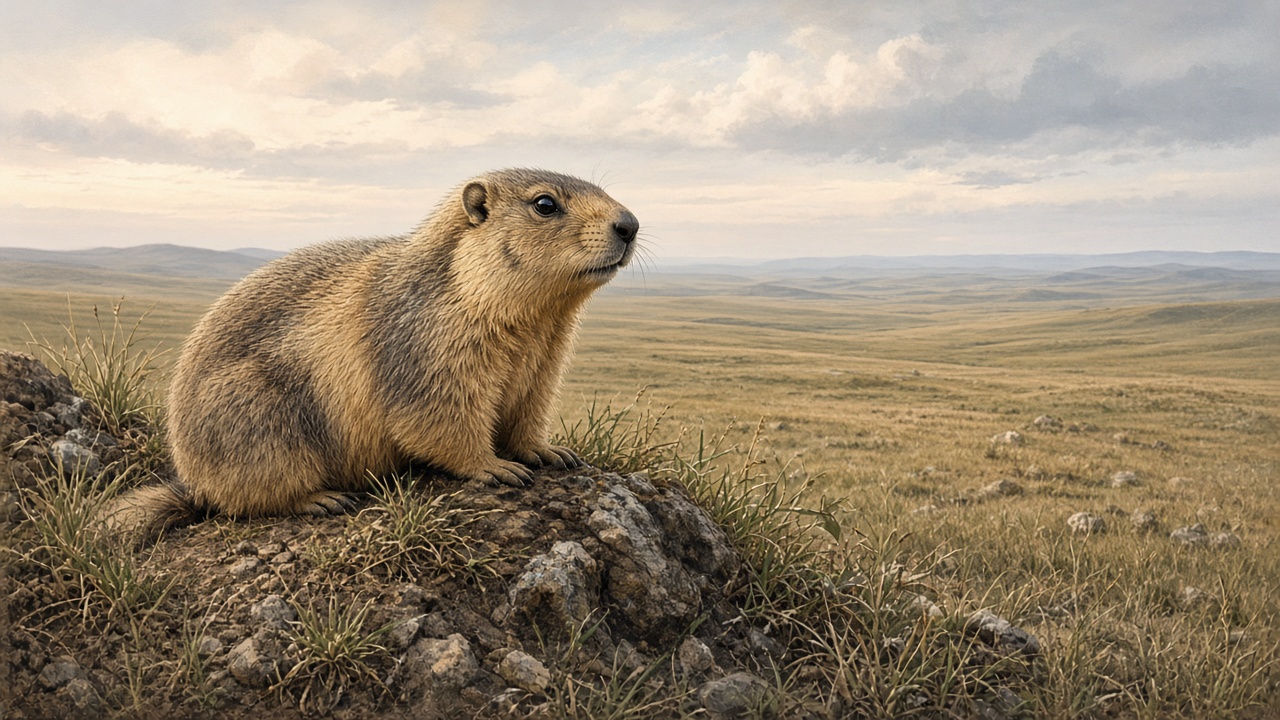
Tarbagan Marmot
Marmota sibiricaNo solid country presence documented yet.
Tarbagan Marmot (Marmota sibirica): ecology sheet across its documented range — natural history and habitats, without hunting framing.
Overview
Tarbagan Marmot (Marmota sibirica) is an ecology sheet across its documented range: natural history and habitats, without any hunting framing.
Classification: order Rodentia, family Sciuridae, genus Marmota. Common names: Tarbagan Marmot in English, Marmotte de Mongolie in French, Marmota de Mongolia in Spanish.
Identification
A stout, short-legged marmot measuring 50 to 60 cm and weighing 6 to 8 kg. The fine, medium-length fur is mainly brown: back light brown to light rusty, often with a whitish-yellow tinge, more reddish-brown in late autumn than in spring. The muzzle, eye area and tail are darker brown and the ears light orange-brown. Very close to the gray marmot, with which it is thought to hybridise, it differs in its smaller size and in a lower jaw markedly larger in males than in females.
Social and territorial, it lives in extended families: a dominant pair, subordinate adults and young, 13 to 18 animals in good conditions and 2 to 6 otherwise. Females usually breed every other year: mating in April, 40 to 42 days of gestation, births at the end of May, 4 to 6 young (up to 8). The young stay in the family for at least three years. A herbivore, it eats mainly grasses, then more herbs in the second half of summer, plus sagebrush. Wolves, red foxes, raptors, brown bears and snow leopards prey on it.
Habitats and range
Found mainly in Mongolia, it also occurs in China (Inner Mongolia, Heilongjiang) and Russia (Siberia, Tuva, Transbaikalia), according to MDD and ADW. The subspecies sibirica lives on the lower eastern steppes, caliginosus in the mountains of the north, west and centre (Khangai, Khövsgöl, Mongolian Altai). It uses steppe, alpine meadows, forest steppe, semi-desert and valleys, from about 600 to 3,000 m and exceptionally 3,800 m.
The countries where the species’ presence is established are shown in the tags on this sheet.
Field signs
Most active in the forenoon, it is found by its burrows and spoil mounds, covered by distinctive vegetation often dominated by a single plant. Its alarm call is unique to the species and separates it from the gray marmot. Before hibernation it seals its burrows with soil, sticks, droppings and leaves. Corsac foxes reuse its abandoned burrows on the arid steppe.
Conservation
For conservation status of Marmota sibirica, consult the current IUCN assessment and cross with national monitoring programmes in countries of documented presence. Never turn a global IUCN category into a local hunting rule. GBIF occurrences help situate distribution but remain effort-biased.
The IUCN lists it as Endangered: 70% of the population was lost in the 1990s. ADW attributes the decline to overexploitation for meat and fur — 104.2 million skins were prepared in Mongolia between 1906 and 1994 — and to extermination campaigns driven by plague, which it transmits: the 1911 outbreak killed 50,000 people. In Russia it has become rare in the wild.
Limits
This sheet on the Tarbagan Marmot covers biology and ecology only; it publishes no hunting season, quota or authorisation.
Local densities and management plans are not covered here: they are a matter for the managers of each area.
Sources
Sources consulted for this sheet:
- IUCN Red List — species search (consulted 2026-11-02)
- ASM Mammal Diversity Database — Marmota sibirica (consulted 2026-11-02)
- GBIF — species search (consulted 2026-11-02)
- Animal Diversity Web — Marmota sibirica (Tarbagan marmot) (consulted 2026-11-04)
Conclusion
In short: use the scientific name Marmota sibirica to cross-check sources, confirm taxonomy and conservation status on the institutional portals listed above, and relate every field sign to the habitat where it was actually found.
Identification
Marmota sibirica
Marmotte de Mongolie · preferred
Marmota de Mongolia · preferred
Tarbagan Marmot · preferred
Mongolian Marmot
Siberian Marmot
Classification
Class : Mammalia
Order : Rodentia
Family : Sciuridae
Genus : Marmota
Conservation
IUCN : EN
CITES : —
iucn · EN (global)
Habitat
Frequently asked questions
How do I recognise Tarbagan Marmot?
Use Marmota sibirica as the scientific anchor. A stout, short-legged marmot measuring 50 to 60 cm and weighing 6 to 8 kg. The fine, medium-length fur is mainly brown: back light brown to light rusty, often with a whitish-yellow tinge, more reddish-brown in late autumn than in spring. The muzzle, eye area and tail are darker b...
Where does Tarbagan Marmot typically live?
Found mainly in Mongolia, it also occurs in China (Inner Mongolia, Heilongjiang) and Russia (Siberia, Tuva, Transbaikalia), according to MDD and ADW. The subspecies sibirica lives on the lower eastern steppes, caliginosus in the mountains of the north, west and centre (Khangai, Khövsgöl, Mongolian Altai). It uses steppe, alpine meadows, forest steppe, semi-d...
What field signs help confirm Tarbagan Marmot?
Most active in the forenoon, it is found by its burrows and spoil mounds, covered by distinctive vegetation often dominated by a single plant. Its alarm call is unique to the species and separates it from the gray marmot. Before hibernation it seals its burrows with soil, sticks, droppings and leaves. Corsac foxes reuse its abandoned burrows on the arid step...