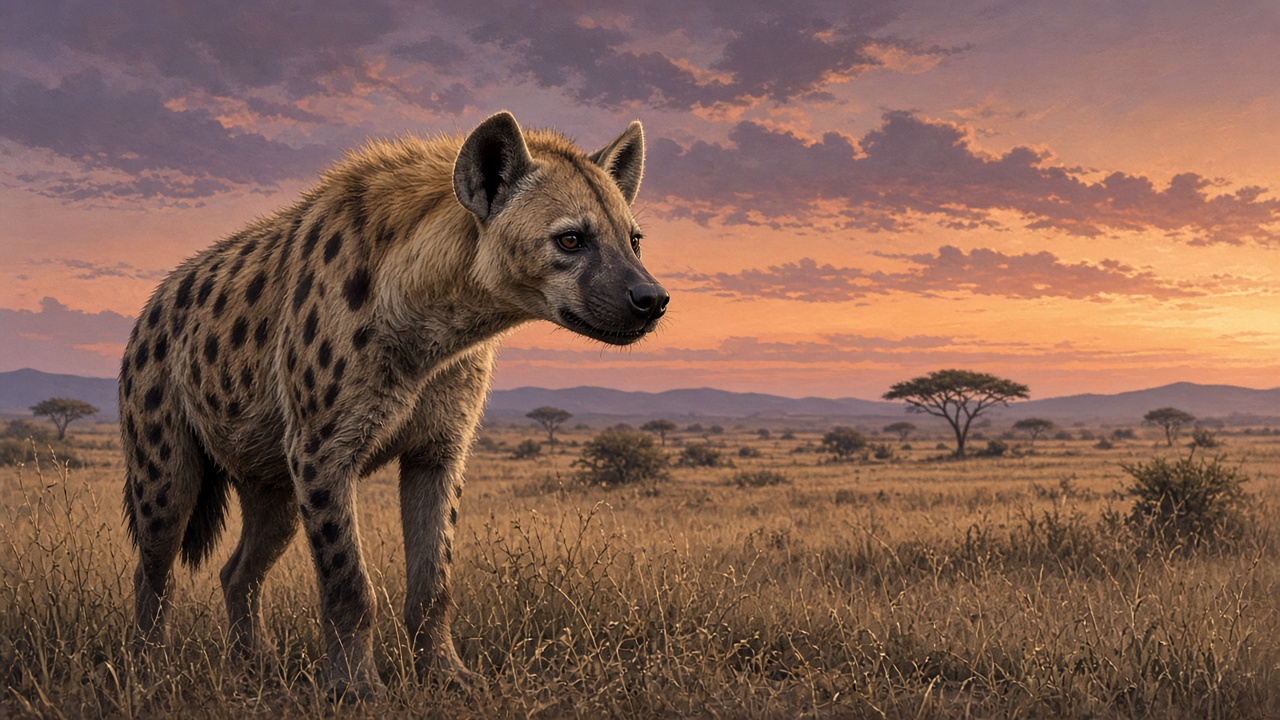
Spotted Hyena
Crocuta crocutaSpotted Hyena (Crocuta crocuta): coexistence sheet across its documented range — presence, biology and prudence, without an invented hunting status.
Seen in: Namibia · South Africa
Overview
Spotted Hyena (Crocuta crocuta) is a coexistence sheet across its documented range: presence, biology and prudence — not a hunting status claim.
Classification: order Carnivora, family Hyaenidae, genus Crocuta. Common names: Spotted Hyena in English, Hyène tachetée in French, Hiena manchada in Spanish.
Identification
A powerfully built hyena with a massive neck, a large head and rounded ears, unlike the other hyenas. The coarse, woolly coat is sandy, yellowish or grey, covered with black or dark brown spots that are darkest in young animals and can almost vanish in very old ones. It measures 95 to 150 cm, 75 to 85 cm at the shoulder, with a 30 to 36 cm tail ending in a bushy black tip; forelegs longer than hind legs give the back a downward slope. Females are heavier than males (55 to over 70 kg against 45 to 60 kg) and their external genitalia look like a male’s.
Far from being mainly a scavenger, it kills most of its own food (70% of the diet in one Kalahari study): wildebeest, zebra, gazelles and many others, chased at up to 60 km/h. It lives in matrilineal clans of 3 to 80 members in which all females dominate all males. Breeding can occur all year; after about 110 days, usually two cubs are born, almost black and with their eyes open, and are weaned at 12 to 16 months. Lions are the main animals that kill it.
Habitats and range
Found throughout sub-Saharan Africa at very variable densities, it has disappeared from most of South Africa; until the end of the Pleistocene it also ranged across Eurasia. It uses many open, dry habitats: semi-desert, savanna, acacia bush and mountain forest, up to 4,000 m in East Africa and Ethiopia. It becomes scarcer in dense forest and is absent from the coastal tropical rainforest of West and Central Africa.
The countries where the species’ presence is established are shown in the tags on this sheet.
Field signs
Its voice is the best clue: the whoop, a contact call, and the famous giggle, linked to fear or excitement and often given by an animal being chased. Clans mark their territory with scent secretions and communal latrines along the boundaries. Cubs are born in an old aardvark, warthog or bat-eared fox burrow and then moved to a communal den; gatherings at carcasses also reveal its presence.
Conservation
For conservation status of Crocuta crocuta, consult the current IUCN assessment and cross with national monitoring programmes in countries of documented presence. Never turn a global IUCN category into a local hunting rule. GBIF occurrences help situate distribution but remain effort-biased.
The IUCN lists it as Least Concern; the IUCN Hyaena Specialist Group has described it as conservation dependent. Conflict with people weighs on it: it preys on livestock and was long shot on sight in East African parks and reserves, until the early 1960s. It remains the most numerous large predator in the Serengeti.
Limits
This sheet on the Spotted Hyena covers presence and biology. A species being present in a country does not mean it may be hunted, and no season or quota is published here.
Local densities and management plans are not covered here: they are a matter for the managers of each area.
Sources
Sources consulted for this sheet:
- IUCN Red List — species search (consulted 2026-11-02)
- ASM Mammal Diversity Database — Crocuta crocuta (consulted 2026-11-02)
- GBIF — species search (consulted 2026-11-02)
- Animal Diversity Web — Crocuta crocuta (spotted hyena) (consulted 2026-11-04)
Conclusion
In short: use the scientific name Crocuta crocuta to cross-check sources, confirm taxonomy and conservation status on the institutional portals listed above, and relate every field sign to the habitat where it was actually found.
Identification
Crocuta crocuta
Spotted Hyena · preferred
Hyène tachetée · preferred
Hiena manchada · preferred
Classification
Class : Mammalia
Order : Carnivora
Family : Hyaenidae
Genus : Crocuta
Conservation
IUCN : LC
CITES : —
iucn · LC (global)
Habitat
Frequently asked questions
How do I recognise Spotted Hyena?
Use Crocuta crocuta as the scientific anchor. A powerfully built hyena with a massive neck, a large head and rounded ears, unlike the other hyenas. The coarse, woolly coat is sandy, yellowish or grey, covered with black or dark brown spots that are darkest in young animals and can almost vanish in very old ones. It measures...
Where does Spotted Hyena typically live?
Found throughout sub-Saharan Africa at very variable densities, it has disappeared from most of South Africa; until the end of the Pleistocene it also ranged across Eurasia. It uses many open, dry habitats: semi-desert, savanna, acacia bush and mountain forest, up to 4,000 m in East Africa and Ethiopia. It becomes scarcer in dense forest and is absent from t...
What field signs help confirm Spotted Hyena?
Its voice is the best clue: the whoop, a contact call, and the famous giggle, linked to fear or excitement and often given by an animal being chased. Clans mark their territory with scent secretions and communal latrines along the boundaries. Cubs are born in an old aardvark, warthog or bat-eared fox burrow and then moved to a communal den; gatherings at car...