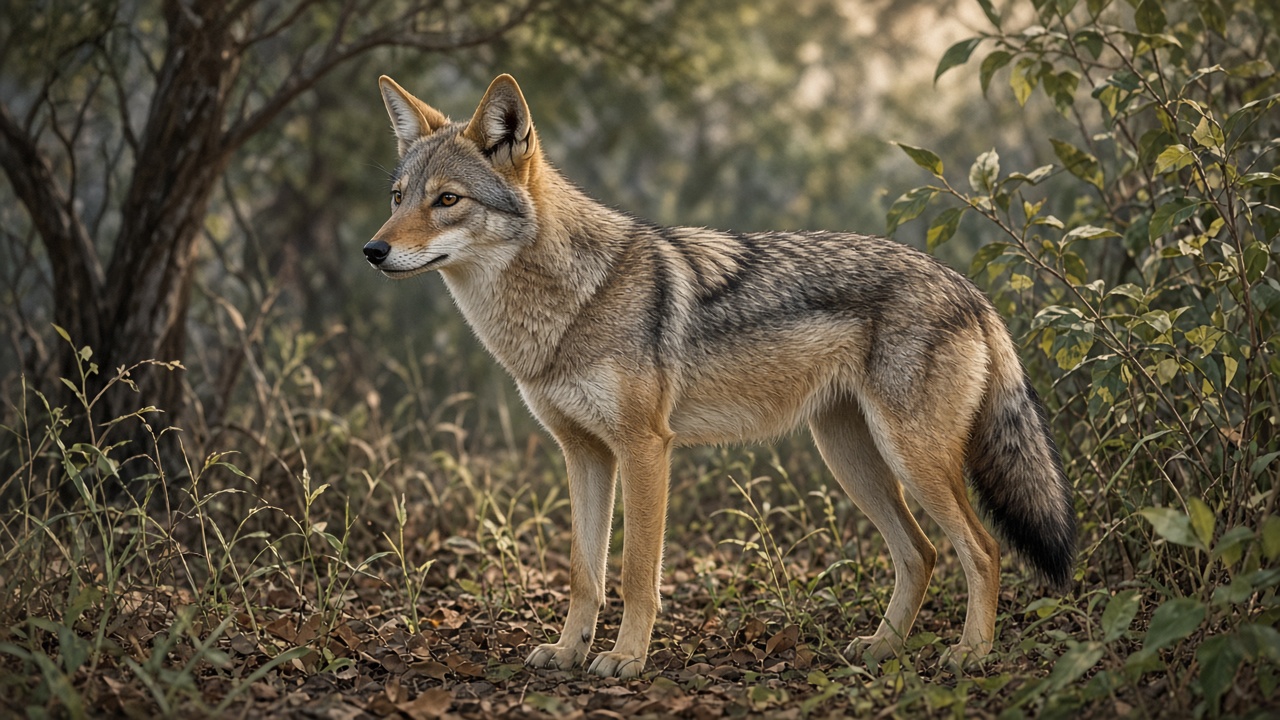
Side-striped Jackal
Lupulella adustaSide-striped Jackal (Lupulella adusta): biology, habitats and field signs across its documented range, hunting-context reading.
Seen in: Namibia · South Africa
Overview
Side-striped Jackal (Lupulella adusta) is presented here in a hunting-context reading across its documented range: biology, habitats and field signs useful to observers — without publishing season, quota or authorisation.
Classification: order Carnivora, family Canidae, genus Lupulella. Common names: Side-striped Jackal in English, Chacal à flancs rayés in French, Chacal de flancos rayados in Spanish.
Identification
A heavily built jackal, drabber than its relatives, with shorter legs and ears. The coat is light grey to tan; a white stripe runs from elbow to hip, with black side stripes that are not always conspicuous. The fairly dark tail ends in a white tip, a good identification feature. Males are somewhat larger than females: 7.3 to 12 kg for males, while females seldom exceed 10 kg.
Strictly nocturnal, with peak activity in the evening and before dawn. It lives alone or in pairs, sometimes in groups of up to six; packs of 8 to 12 are extremely rare. Pairs mate for life and are territorial, marking and defending their boundaries. An omnivorous scavenger, it eats insects, fruit, small vertebrates, carrion and plant matter, catching mice and birds with a quick dash or pounce but never running prey down. Mating comes just before or during the rainy season; after 57 to 70 days, 3 to 6 young are born. Leopards, hyenas and eagles prey on it.
Habitats and range
It is a jackal of tropical Africa, roughly between 15° N and 23° S; MDD lists it in 38 countries, from Senegal and Mauritania to Somalia and south to South Africa. It favours moist habitats: woodland, savanna and thickets, marshes, bushland, grassland and mountains up to 2,700 m, as well as cultivated land. It does not live in the rainforests of West and Central Africa.
The countries where the species’ presence is established are shown in the tags on this sheet.
Field signs
Active at night, it is best detected by voice: instead of howling, it gives an owl-like hoot that the Karamojong render as “o loo”. Families gather with yipping calls, and threatened animals scream loudly. The white tail tip and pale flank stripe are the best visual features; it is often seen crossing major roads.
Conservation
For conservation status of Lupulella adusta, consult the current IUCN assessment and cross with national monitoring programmes in countries of documented presence. Never turn a global IUCN category into a local hunting rule. GBIF occurrences help situate distribution but remain effort-biased.
ADW lists it as Least Concern: relatively rare throughout its range but not threatened, despite distemper epidemics in the early 20th century and trapping and poisoning during rabies outbreaks, a disease for which it is a reservoir. MDD shows it as Not Evaluated under Lupulella adusta: the species was moved from Canis to Lupulella (Viranta et al., 2017), and the IUCN assesses it under the spelling Lupulella adustus.
Limits
This sheet on the Side-striped Jackal publishes no season, quota, hunting method or fee: those rules differ between countries and territories and must be checked in official texts. Being described here does not mean a species may be hunted.
Local densities and management plans are not covered here: they are a matter for the managers of each area.
Sources
Sources consulted for this sheet:
- IUCN Red List — species search (consulted 2026-11-02)
- ASM Mammal Diversity Database — Lupulella adusta (consulted 2026-11-02)
- GBIF — species search (consulted 2026-11-02)
- Animal Diversity Web — Canis adustus (side-striped jackal) (consulted 2026-11-04)
Conclusion
In short: use the scientific name Lupulella adusta to cross-check sources, confirm taxonomy and conservation status on the institutional portals listed above, and relate every field sign to the habitat where it was actually found.
Identification
Lupulella adusta
Side-striped Jackal · preferred
Chacal à flancs rayés · preferred
Chacal de flancos rayados · preferred
Canis adustus
Lupulella adustus
Classification
Class : Mammalia
Order : Carnivora
Family : Canidae
Genus : Lupulella
Conservation
IUCN : LC
CITES : —
iucn · LC (global)
Habitat
Frequently asked questions
How do I recognise Side-striped Jackal?
Use Lupulella adusta as the scientific anchor. A heavily built jackal, drabber than its relatives, with shorter legs and ears. The coat is light grey to tan; a white stripe runs from elbow to hip, with black side stripes that are not always conspicuous. The fairly dark tail ends in a white tip, a good identification feature....
Where does Side-striped Jackal typically live?
It is a jackal of tropical Africa, roughly between 15° N and 23° S; MDD lists it in 38 countries, from Senegal and Mauritania to Somalia and south to South Africa. It favours moist habitats: woodland, savanna and thickets, marshes, bushland, grassland and mountains up to 2,700 m, as well as cultivated land. It does not live in the rainforests of West and Cen...
What field signs help confirm Side-striped Jackal?
Active at night, it is best detected by voice: instead of howling, it gives an owl-like hoot that the Karamojong render as “o loo”. Families gather with yipping calls, and threatened animals scream loudly. The white tail tip and pale flank stripe are the best visual features; it is often seen crossing major roads.