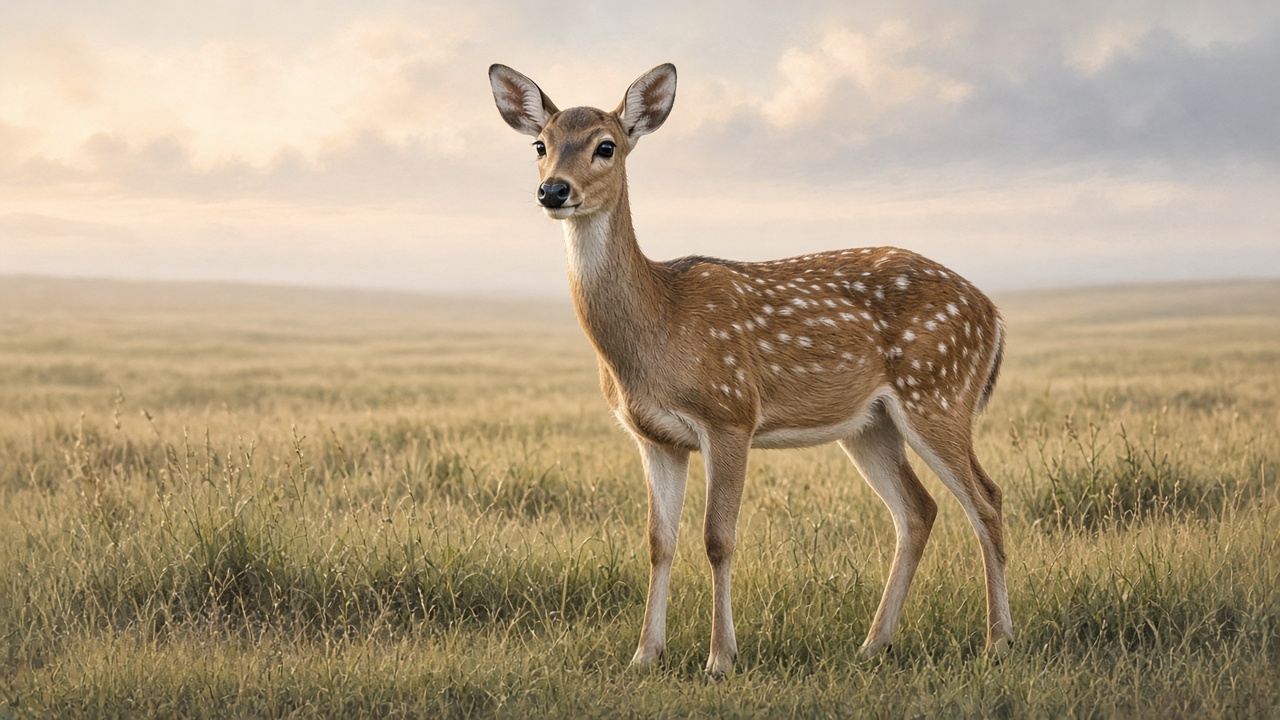
Pampas Deer (Ozotoceros bezoarticus): biology, habitats and field signs across its documented range, hunting-context reading.
Seen in: Argentina
Overview
Pampas Deer (Ozotoceros bezoarticus) is presented here in a hunting-context reading across its documented range: biology, habitats and field signs useful to observers — without publishing season, quota or authorisation.
Classification: order Artiodactyla, family Cervidae, genus Ozotoceros. Common names: Pampas Deer in English, Cerf des pampas in French, Venado de las pampas in Spanish.
Identification
A medium-sized, lightly built deer: 110 to 140 cm long, 70 to 75 cm at the shoulder and 30 to 40 kg. The upperparts and legs are reddish brown or yellowish grey, with a darker face, crown and tail; cream areas mark the inside of the ears, the eye ring, throat, chest, belly, underside of the tail and the tarsal tufts. The coat changes little between summer and winter. Only males, barely larger than females, carry antlers with three tines; chestnut fawns have rows of white spots that fade by about two months.
A herbivore, it seems to select fresh green growth, also browses shrubs and eats grass seed-heads. Most fawns are born in the southern spring, September to November, after a gestation of just over seven months: almost always a single fawn, and a female can give birth at ten-month intervals. Males cast their antlers in midwinter and regrow them at once. In the rut, males fight, thrash vegetation with their antlers and rub their head glands on plants, with no territories or harems.
Habitats and range
It once ranged across all the natural grasslands of eastern South America between 5° and 40° south; it now survives only in local populations. MDD lists it in northern Argentina, south-eastern Bolivia, Brazil south of the Amazon, Paraguay and Uruguay. It uses a range of open, low-lying grasslands: ground temporarily flooded by fresh or estuarine water, rolling hills and areas with winter drought and no permanent surface water, sometimes in grass tall enough to hide a standing deer.
The countries where the species’ presence is established are shown in the tags on this sheet.
Field signs
Usually seen alone or in small groups of five or six at most, it can gather in groups of 50 or more on shared grazing grounds, where it lies in the open to ruminate in fair weather. Its hind interdigital glands give off a pungent, lingering, onion-like smell that carries up to 1.5 km, strongest at bedding sites and along regular paths. When alarmed it stares, stamps, snorts and raises its tail.
Conservation
For conservation status of Ozotoceros bezoarticus, consult the current IUCN assessment and cross with national monitoring programmes in countries of documented presence. Never turn a global IUCN category into a local hunting rule. GBIF occurrences help situate distribution but remain effort-biased.
MDD gives its IUCN status as Near Threatened; ADW notes it is on CITES Appendix I. Once very abundant on the pampas of Argentina and Uruguay, it declined through habitat loss, disease from livestock and uncontrolled commercial exploitation: over 2 million skins are estimated to have left Argentina between 1860 and 1870. It also competes with livestock, especially sheep. Three subspecies have been described on the basis of coat colour.
Limits
This sheet on the Pampas Deer publishes no season, quota, hunting method or fee: those rules differ between countries and territories and must be checked in official texts. Being described here does not mean a species may be hunted.
Local densities and management plans are not covered here: they are a matter for the managers of each area.
Sources
Sources consulted for this sheet:
- IUCN Red List — species search (consulted 2026-11-02)
- ASM Mammal Diversity Database — Ozotoceros bezoarticus (consulted 2026-11-02)
- GBIF — species search (consulted 2026-11-02)
- Animal Diversity Web — Ozotoceros bezoarticus (Pampas deer) (consulted 2026-11-04)
Conclusion
In short: use the scientific name Ozotoceros bezoarticus to cross-check sources, confirm taxonomy and conservation status on the institutional portals listed above, and relate every field sign to the habitat where it was actually found.
Identification
Ozotoceros bezoarticus
Pampas Deer · preferred
Cerf des pampas · preferred
Venado de las pampas · preferred
Classification
Class : Mammalia
Order : Artiodactyla
Family : Cervidae
Genus : Ozotoceros
Conservation
IUCN : NT
CITES : —
iucn · NT (global)
Habitat
Frequently asked questions
How do I recognise Pampas Deer?
Use Ozotoceros bezoarticus as the scientific anchor. A medium-sized, lightly built deer: 110 to 140 cm long, 70 to 75 cm at the shoulder and 30 to 40 kg. The upperparts and legs are reddish brown or yellowish grey, with a darker face, crown and tail; cream areas mark the inside of the ears, the eye ring, throat, chest, belly, under...
Where does Pampas Deer typically live?
It once ranged across all the natural grasslands of eastern South America between 5° and 40° south; it now survives only in local populations. MDD lists it in northern Argentina, south-eastern Bolivia, Brazil south of the Amazon, Paraguay and Uruguay. It uses a range of open, low-lying grasslands: ground temporarily flooded by fresh or estuarine water, rolli...
What field signs help confirm Pampas Deer?
Usually seen alone or in small groups of five or six at most, it can gather in groups of 50 or more on shared grazing grounds, where it lies in the open to ruminate in fair weather. Its hind interdigital glands give off a pungent, lingering, onion-like smell that carries up to 1.5 km, strongest at bedding sites and along regular paths. When alarmed it stares...