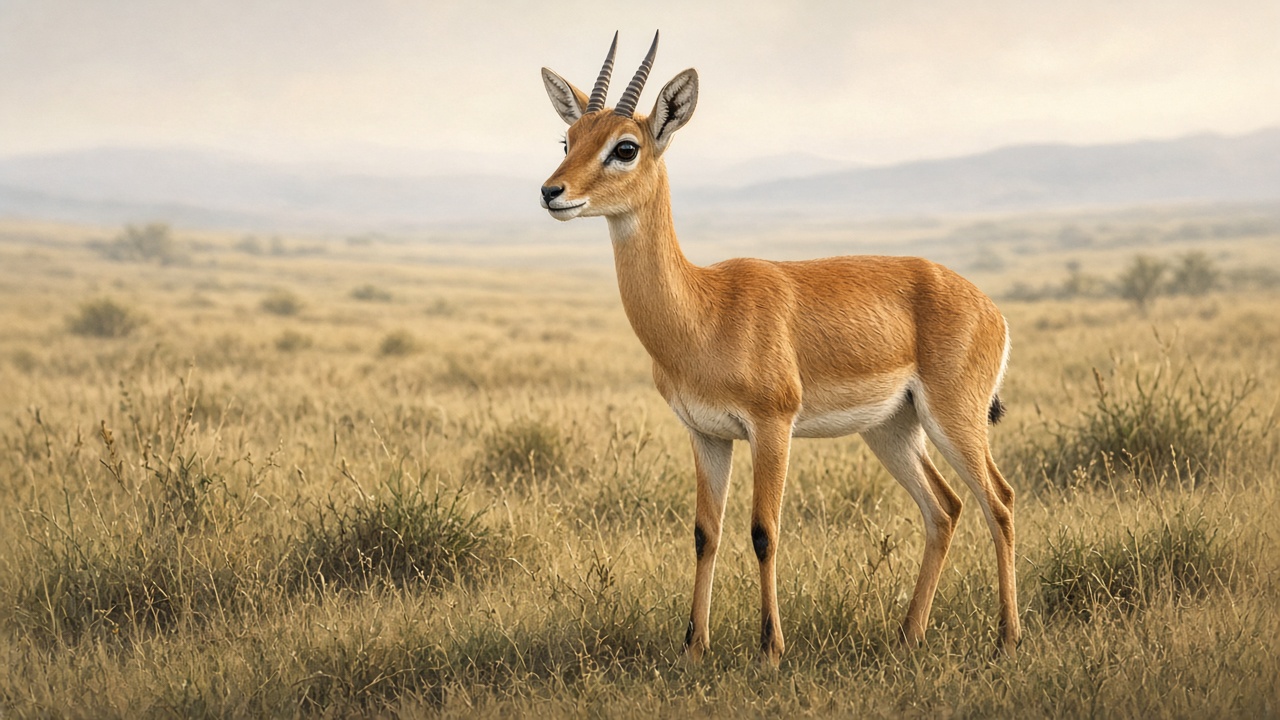
Oribi (Ourebia ourebi): coexistence sheet across its documented range — presence, biology and prudence, without an invented hunting status.
Seen in: Namibia · South Africa
Overview
Oribi (Ourebia ourebi) is a coexistence sheet across its documented range: presence, biology and prudence — not a hunting status claim.
Classification: order Artiodactyla, family Bovidae, genus Ourebia. Common names: Oribi in English, Ourébi in French, Ourebi in Spanish.
Identification
The oribi is a small, slender antelope with very long legs and neck: 92 to 110 cm long, 50 to 66 cm at the shoulder and 12 to 22 kg. Its silky coat ranges from yellow to reddish brown, with white underparts and rump. It has a white line above the eye, a bare dark patch below each ear, a tuft of long hair on each “knee” and a short black tail. The very large preorbital glands show as vertical folds between eye and mouth. Only males carry small, straight, spike-like horns, 8 to 19 cm long.
It grazes fresh grass in the wet season and switches to browsing foliage during drought; at least eleven herbs and seven tree species are on its menu, and it visits mineral licks every one to three days. It breeds all year, with a peak in October and November; after a six- to seven-month gestation a single young is born and weaned at four to five months. The male holds a territory shared with one, two or more females. Leopards, caracals and pythons are its enemies; jackals, ratels, baboons, eagles and monitor lizards take young.
Habitats and range
Its distribution is patchy across the savannas of central and southern Africa. MDD lists it from Senegal and Gambia to western Ethiopia and northern Eritrea, then south through East Africa to Angola, northern Botswana, Mozambique, eastern South Africa and Lesotho. It lives in open grassland with short grass, broken by patches of taller grass for hiding and a few bushes, and avoids very tall or dense grass as well as steep slopes.
The countries where the species’ presence is established are shown in the tags on this sheet.
Field signs
Active mostly by day, it is seen alone, in pairs or in small groups of up to six. It returns to burnt ground as soon as a fire is over to graze the fresh green regrowth, so recent burns are good places to look. The male patrols his territory and marks grass stems with a black secretion from his preorbital glands, combined with urine and dung. It sometimes enters wheat or oat fields, which resemble its natural forage.
Conservation
For conservation status of Ourebia ourebi, consult the current IUCN assessment and cross with national monitoring programmes in countries of documented presence. Never turn a global IUCN category into a local hunting rule. GBIF occurrences help situate distribution but remain effort-biased.
The IUCN lists it as Least Concern (MDD, ADW). ADW cites agricultural and urban expansion, bush encroachment and poaching as threats and stresses the role of protected areas for the species. MDD notes it may be extinct in Burundi and includes in Ourebia ourebi the forms hastata, montana and quadriscopa, which Groves and Grubb (2011) treated as separate species.
Limits
This sheet on the Oribi covers presence and biology. A species being present in a country does not mean it may be hunted, and no season or quota is published here.
Local densities and management plans are not covered here: they are a matter for the managers of each area.
Sources
Sources consulted for this sheet:
- IUCN Red List — species search (consulted 2026-11-02)
- ASM Mammal Diversity Database — Ourebia ourebi (consulted 2026-11-02)
- GBIF — species search (consulted 2026-11-02)
- Animal Diversity Web — Ourebia ourebi (oribi) (consulted 2026-11-04)
Conclusion
In short: use the scientific name Ourebia ourebi to cross-check sources, confirm taxonomy and conservation status on the institutional portals listed above, and relate every field sign to the habitat where it was actually found.
Identification
Ourebia ourebi
Oribi · preferred
Ourébi · preferred
Ourebi · preferred
Oorbietjie
Western Oribi
Sudan Oribi
Central Oribi
Southern Oribi
Classification
Class : Mammalia
Order : Artiodactyla
Family : Bovidae
Genus : Ourebia
Conservation
IUCN : LC
CITES : —
iucn · LC (global)
Habitat
Frequently asked questions
How do I recognise Oribi?
Use Ourebia ourebi as the scientific anchor. The oribi is a small, slender antelope with very long legs and neck: 92 to 110 cm long, 50 to 66 cm at the shoulder and 12 to 22 kg. Its silky coat ranges from yellow to reddish brown, with white underparts and rump. It has a white line above the eye, a bare dark patch below each...
Where does Oribi typically live?
Its distribution is patchy across the savannas of central and southern Africa. MDD lists it from Senegal and Gambia to western Ethiopia and northern Eritrea, then south through East Africa to Angola, northern Botswana, Mozambique, eastern South Africa and Lesotho. It lives in open grassland with short grass, broken by patches of taller grass for hiding and a...
What field signs help confirm Oribi?
Active mostly by day, it is seen alone, in pairs or in small groups of up to six. It returns to burnt ground as soon as a fire is over to graze the fresh green regrowth, so recent burns are good places to look. The male patrols his territory and marks grass stems with a black secretion from his preorbital glands, combined with urine and dung. It sometimes en...