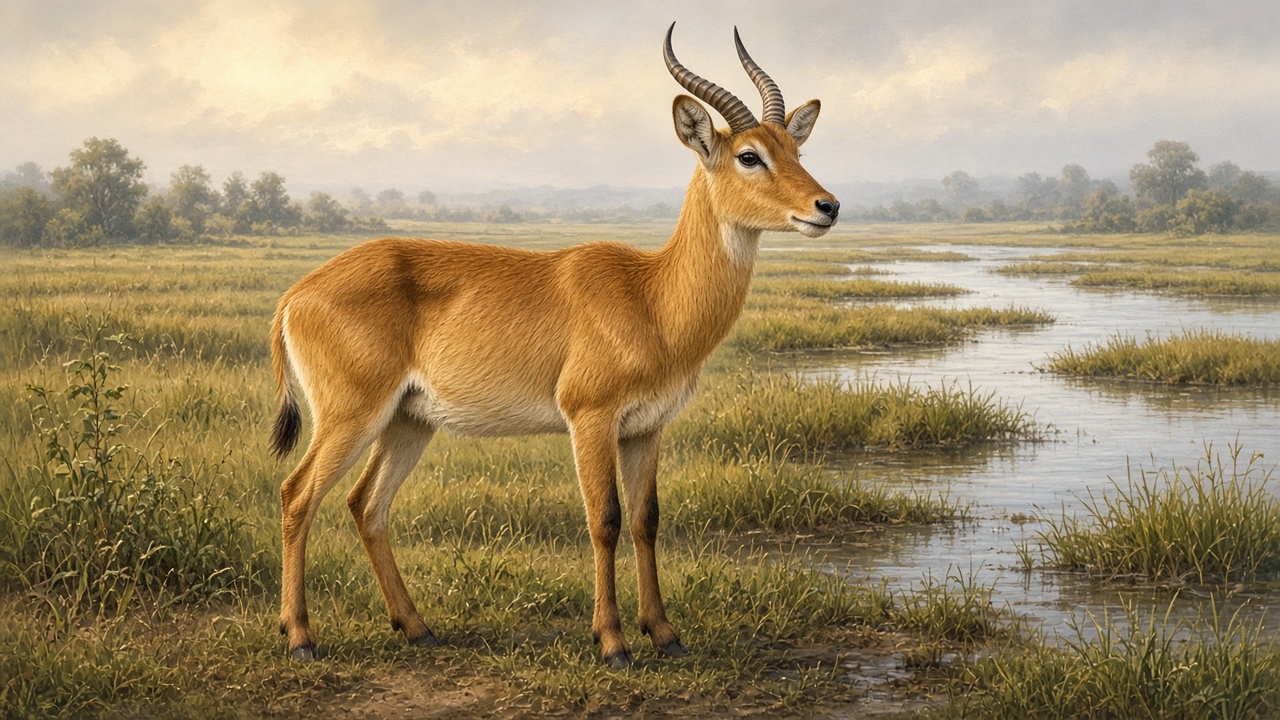
Kob
Kobus kobNo solid country presence documented yet.
Kob (Kobus kob): coexistence sheet across its documented range — presence, biology and prudence, without an invented hunting status.
Overview
Kob (Kobus kob) is a coexistence sheet across its documented range: presence, biology and prudence — not a hunting status claim.
Classification: order Artiodactyla, family Bovidae, genus Kobus. Common names: Kob in English, Cobe de Buffon in French, Kob in Spanish.
Identification
The kob stands about 92 cm at the shoulder and weighs 90 to 120 kg. Its short coat is reddish-brown, with a white throat patch and white underparts; a black stripe runs down the front of the forelegs. Only males carry horns, averaging 44 cm, ridged with transverse corrugations, curved and turning up at the tips. The many subspecies differ mainly in how dark the coat is; MDD includes the forms leucotis (white-eared kob), loderi and thomasi (Uganda kob) in this species.
A herbivore, it eats grasses and reeds. Mostly active in the morning and evening, it forms mixed herds of females and young males under eight months, whose size changes quickly, alongside herds of non-breeding males. Where densities are high, breeding takes place on leks: 20 to 200 males defend small territories 15 to 200 m across, which females visit only to mate. After 8 to 9 months of gestation a single calf is born; Uganda kob at Boma give birth in November and December. Lions, spotted hyenas and African wild dogs are its predators.
Habitats and range
It lives in the moist savannas of Africa, from Senegal to western Kenya, where it is now extinct. MDD lists it from Senegal, Guinea, Côte d’Ivoire, Ghana, Nigeria, Cameroon, the Central African Republic, southern Chad, South Sudan, Uganda and the northern Democratic Republic of the Congo, among others, and in Ethiopia only in the Gambela Salient. It stays near permanent water: moist savanna, floodplains and the margins of nearby woodland. Females prefer open lek sites with short grass on raised ground.
The countries where the species’ presence is established are shown in the tags on this sheet.
Field signs
On a lek, dozens of males each hold a small territory, packed most tightly in the centre, where most matings happen, on open ground with short grass. Female herds change size from one day to the next. In the dry season some populations migrate to graze along watercourses: in south-eastern Sudan one travelled 150 to 200 km, reaching up to 1,000 kob per km².
Conservation
For conservation status of Kobus kob, consult the current IUCN assessment and cross with national monitoring programmes in countries of documented presence. Never turn a global IUCN category into a local hunting rule. GBIF occurrences help situate distribution but remain effort-biased.
The IUCN lists it as Least Concern. Its range has shrunk greatly: MDD gives it as extinct in Gambia, western Kenya, Sierra Leone and north-western Tanzania, and poaching is among its causes of death. It remains common in national parks, and the kob of the Boma grassland ecosystem form the second largest antelope population in Africa. The name Adenota has sometimes been used for a genus or subgenus.
Limits
This sheet on the Kob covers presence and biology. A species being present in a country does not mean it may be hunted, and no season or quota is published here.
Local densities and management plans are not covered here: they are a matter for the managers of each area.
Sources
Sources consulted for this sheet:
- IUCN Red List — species search (consulted 2026-11-02)
- ASM Mammal Diversity Database — Kobus kob (consulted 2026-11-02)
- GBIF — species search (consulted 2026-11-02)
- Animal Diversity Web — Kobus kob (kob) (consulted 2026-11-04)
Conclusion
In short: use the scientific name Kobus kob to cross-check sources, confirm taxonomy and conservation status on the institutional portals listed above, and relate every field sign to the habitat where it was actually found.
Identification
Kobus kob
Cobe de Buffon · preferred
Kob · preferred
Kob · preferred
Senegal Kob
Western Kob
Buffon's Kob
Loder's Kob
Uganda Kob
Thomas's Kob
White-eared Kob
Classification
Class : Mammalia
Order : Artiodactyla
Family : Bovidae
Genus : Kobus
Conservation
IUCN : LC
CITES : —
iucn · LC (global)
Habitat
Frequently asked questions
How do I recognise Kob?
Use Kobus kob as the scientific anchor. The kob stands about 92 cm at the shoulder and weighs 90 to 120 kg. Its short coat is reddish-brown, with a white throat patch and white underparts; a black stripe runs down the front of the forelegs. Only males carry horns, averaging 44 cm, ridged with transverse corrugations, c...
Where does Kob typically live?
It lives in the moist savannas of Africa, from Senegal to western Kenya, where it is now extinct. MDD lists it from Senegal, Guinea, Côte d’Ivoire, Ghana, Nigeria, Cameroon, the Central African Republic, southern Chad, South Sudan, Uganda and the northern Democratic Republic of the Congo, among others, and in Ethiopia only in the Gambela Salient. It stays ne...
What field signs help confirm Kob?
On a lek, dozens of males each hold a small territory, packed most tightly in the centre, where most matings happen, on open ground with short grass. Female herds change size from one day to the next. In the dry season some populations migrate to graze along watercourses: in south-eastern Sudan one travelled 150 to 200 km, reaching up to 1,000 kob per km².