Iberian Ibex
Capra pyrenaicaIberian Ibex (Capra pyrenaica): coexistence sheet across its documented range — presence, biology and prudence, without an invented hunting status.
Seen in: Portugal · Spain
Overview
Iberian Ibex (Capra pyrenaica) is a coexistence sheet across its documented range: presence, biology and prudence — not a hunting status claim.
Classification: order Artiodactyla, family Bovidae, genus Capra. Common names: Iberian Ibex in English, Bouquetin ibérique in French, Cabra montés in Spanish.
Identification
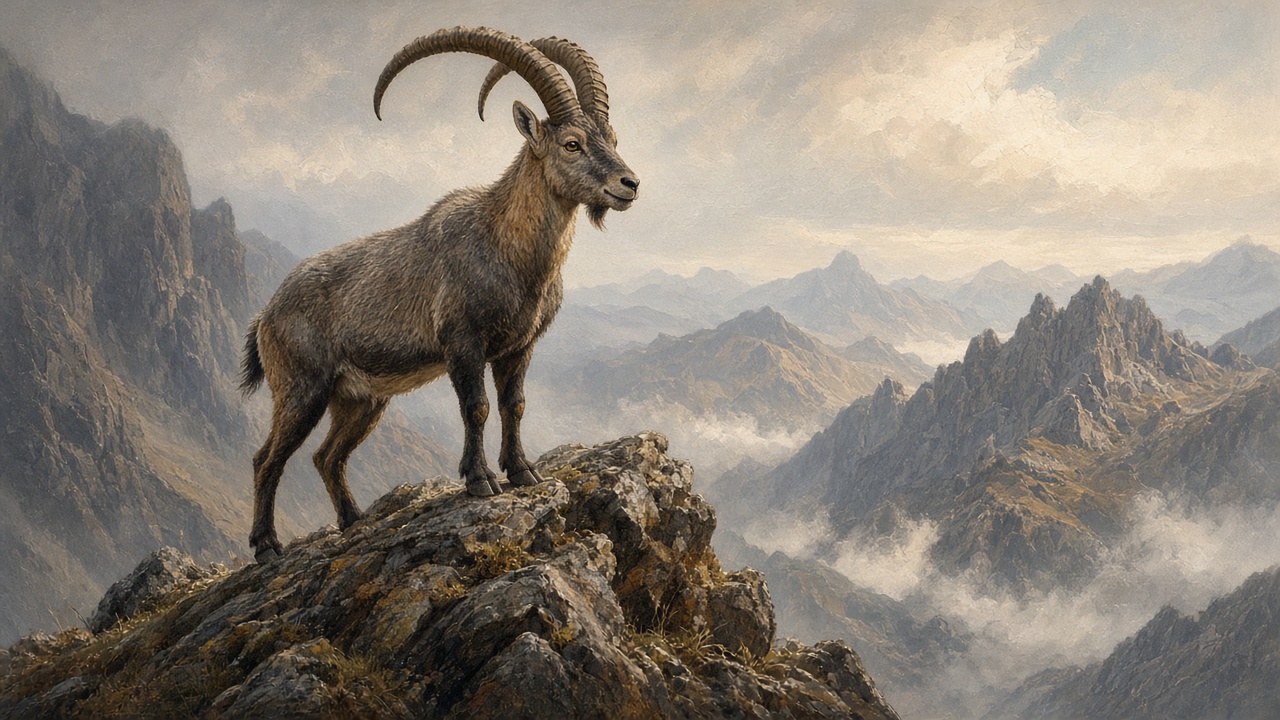
The Iberian ibex, also called the Spanish ibex or Spanish wild goat, has a brownish to greyish coat. It stands 65 to 75 cm at the shoulder and is 100 to 140 cm long, with a 10 to 15 cm tail, and weighs 35 to 80 kg. Males are clearly larger than females. Both sexes have horns, but those of males are much larger and better developed, reaching 75 cm or more and curving back over the head; females’ horns stay short.
The rut runs from November to December, peaking in the first half of December: males clash head to head and only the dominant male in each herd breeds. After 161 to 168 days of gestation, births peak in mid-May, with 1 or 2 young delivered in a remote spot with thick brush. Females are full-grown at 1.5 years, males at 3. It browses mainly holm oak and also eats its acorns, plus some forbs (5%) and grasses (10%), taken more in spring and early summer. Adults have no natural predators apart from humans; eagles and foxes take the young.
Habitats and range
Endemic to the Iberian Peninsula, the species was described from the Pyrenees (type locality Huesca, Aragon); MDD lists it as extinct in Portugal. ADW mentions in particular the Cazorla and Segura ranges and the eastern Sierra Nevada. The Iberian ibex lives in mountainous terrain, generally above 800 m. It prefers forest dotted with rock outcrops, conifers and broadleaf trees, including holm oak, with several canopy layers: the lower layer gives shade to escape the midday heat.
The countries where the species’ presence is established are shown in the tags on this sheet.
Field signs
It lives in herds: for much of the year males keep apart from females and young, with the young of the year travelling in the middle of the group. When danger is detected by sight or smell, an alarm whistle sounds and the herd flees in single file, led by an adult. In November and December, the clash of horns between males marks the rut; females go off alone to give birth before rejoining the herd.
Conservation
For conservation status of Capra pyrenaica, consult the current IUCN assessment and cross with national monitoring programmes in countries of documented presence. Never turn a global IUCN category into a local hunting rule. GBIF occurrences help situate distribution but remain effort-biased.
The IUCN lists it as Least Concern. Conservation work focuses on preserving and restoring habitat and on competition with introduced species such as red deer, released in the Cazorla-Segura park; ADW also notes possible competition with livestock. MDD treats several older names as synonyms, including hispanica, lusitanica and victoriae.
Limits
This sheet on the Iberian Ibex covers presence and biology. A species being present in a country does not mean it may be hunted, and no season or quota is published here.
Local densities and management plans are not covered here: they are a matter for the managers of each area.
Sources
Sources consulted for this sheet:
- IUCN Red List — species search (consulted 2026-11-02)
- ASM Mammal Diversity Database — Capra pyrenaica (consulted 2026-11-02)
- GBIF — species search (consulted 2026-11-02)
- Animal Diversity Web — Capra pyrenaica (Spanish ibex) (consulted 2026-11-04)
Conclusion
In short: use the scientific name Capra pyrenaica to cross-check sources, confirm taxonomy and conservation status on the institutional portals listed above, and relate every field sign to the habitat where it was actually found.
Identification
Capra pyrenaica
Bouquetin ibérique · preferred
Cabra montés · preferred
Iberian Ibex · preferred
Spanish Ibex
Spanish Wild Goat
Classification
Class : Mammalia
Order : Artiodactyla
Family : Bovidae
Genus : Capra
Conservation
IUCN : LC
CITES : —
iucn · LC (global)
Habitat
Practices
Frequently asked questions
How do I recognise Iberian Ibex?
Use Capra pyrenaica as the scientific anchor. The Iberian ibex, also called the Spanish ibex or Spanish wild goat, has a brownish to greyish coat. It stands 65 to 75 cm at the shoulder and is 100 to 140 cm long, with a 10 to 15 cm tail, and weighs 35 to 80 kg. Males are clearly larger than females. Both sexes have horns, but...
Where does Iberian Ibex typically live?
Endemic to the Iberian Peninsula, the species was described from the Pyrenees (type locality Huesca, Aragon); MDD lists it as extinct in Portugal. ADW mentions in particular the Cazorla and Segura ranges and the eastern Sierra Nevada. The Iberian ibex lives in mountainous terrain, generally above 800 m. It prefers forest dotted with rock outcrops, conifers a...
What field signs help confirm Iberian Ibex?
It lives in herds: for much of the year males keep apart from females and young, with the young of the year travelling in the middle of the group. When danger is detected by sight or smell, an alarm whistle sounds and the herd flees in single file, led by an adult. In November and December, the clash of horns between males marks the rut; females go off alone...