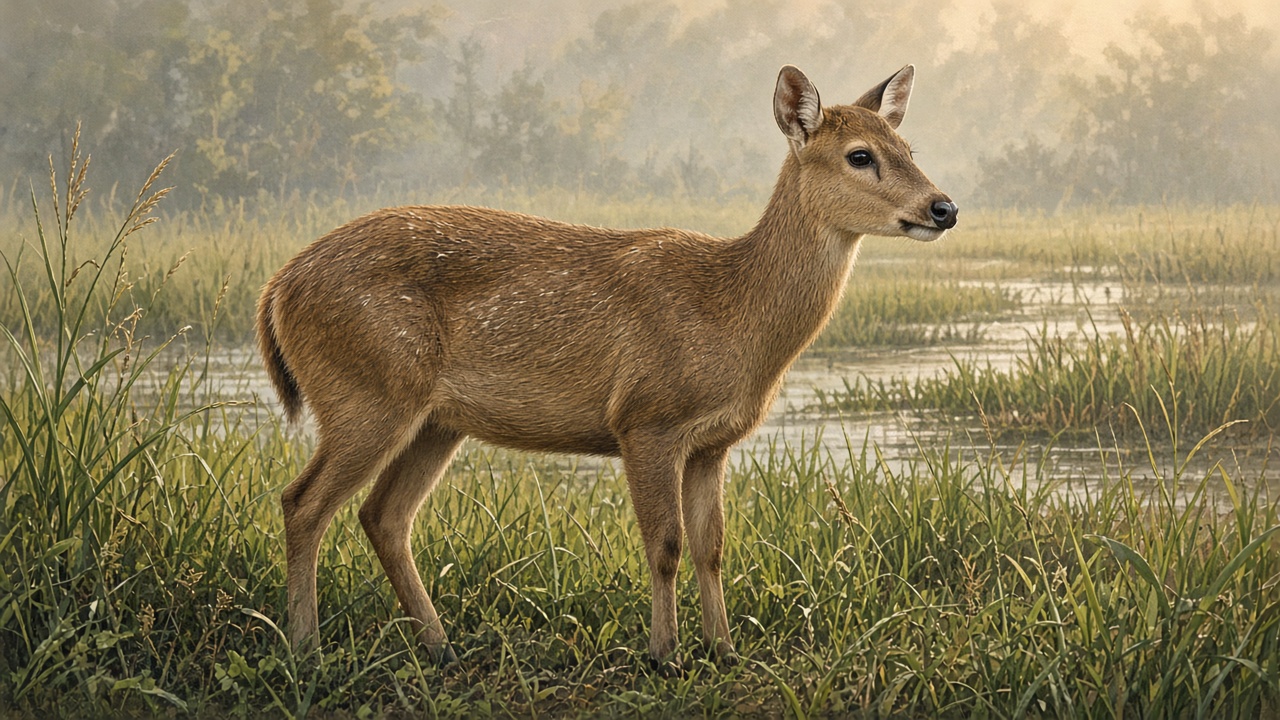
Hog Deer (Axis porcinus): biology, habitats and field signs across its documented range, hunting-context reading.
Seen in: Australia
Overview
Hog Deer (Axis porcinus) is presented here in a hunting-context reading across its documented range: biology, habitats and field signs useful to observers — without publishing season, quota or authorisation.
Classification: order Artiodactyla, family Cervidae, genus Axis. Common names: Hog Deer in English, Cerf cochon in French, Ciervo porcino in Spanish.
Identification
A small, stocky and muscular deer, 125 to 135 cm long and 36 to 50 kg, built for slipping through low cover. The legs are short and slender, the hind legs longer, so the rump stands higher than the shoulders; the face is short and wedge-shaped. The coarse coat is dark olive-brown with white-tipped guard hairs; in summer, fawn-like spots may reappear. The large, rounded ears are fringed with white and the tail is very bushy. Males have thick necks and small antlers, usually three-tined, on hairy pedicles; females are slightly smaller and have no antlers.
Mostly solitary and sedentary, it forages at night, preferring to graze on grasses and leaves, sometimes fruit, including wild cane (Saccharum spontaneum), tamarisk and jujube. Small groups are sometimes seen in clearings where food is plentiful. Males are territorial and mark their ground with glandular secretions. The rut runs from August to October, when males lock antlers and push. After about eight months of gestation, one fawn (sometimes two) is born between May and July and weaned at about six months. Jackals, jungle cats and wolves are among its predators.
Habitats and range
According to MDD, it is native to Pakistan, northern India, Nepal, Bhutan, Bangladesh, Myanmar and Cambodia; it has vanished from China, Laos and Vietnam, and the populations of Thailand, extirpated in the 1960s, have been replaced by introduced animals of unknown origin. The Sri Lankan population was probably introduced several centuries ago, and the species has been introduced to southern Australia. It prefers dense forest but uses clearings, grasslands and wet grasslands depending on the season and food supply; ADW mentions the Indus River forest reserves of Sindh.
The countries where the species’ presence is established are shown in the tags on this sheet.
Field signs
When threatened it does not leap like other deer: it runs off at a trot with its head held low, pig-fashion, hence its name, or takes to the water, as it swims well. It also raises its tail to flash the white hairs beneath and gives warning barks. Mostly nocturnal, it is hard to see; newborn fawns are left hidden for several days in reed beds or grass thickets.
Conservation
For conservation status of Axis porcinus, consult the current IUCN assessment and cross with national monitoring programmes in countries of documented presence. Never turn a global IUCN category into a local hunting rule. GBIF occurrences help situate distribution but remain effort-biased.
The IUCN lists it as Endangered. ADW describes a steep decline, especially in Pakistan, caused by habitat destruction and hunting pressure; human control of Indus floods is drying out much of its natural habitat. Introduced to Hawaii, it is blamed for ecological damage there. MDD includes annamiticus in the species, which Groves and Grubb (2011) treated as distinct.
Limits
This sheet on the Hog Deer publishes no season, quota, hunting method or fee: those rules differ between countries and territories and must be checked in official texts. Being described here does not mean a species may be hunted.
Local densities and management plans are not covered here: they are a matter for the managers of each area.
Sources
Sources consulted for this sheet:
- IUCN Red List — species search (consulted 2026-11-02)
- ASM Mammal Diversity Database — Axis porcinus (consulted 2026-11-02)
- GBIF — species search (consulted 2026-11-02)
- Animal Diversity Web — Axis porcinus (hog deer) (consulted 2026-11-04)
Conclusion
In short: use the scientific name Axis porcinus to cross-check sources, confirm taxonomy and conservation status on the institutional portals listed above, and relate every field sign to the habitat where it was actually found.
Identification
Axis porcinus
Hog Deer · preferred
Cerf cochon · preferred
Ciervo porcino · preferred
Classification
Class : Mammalia
Order : Artiodactyla
Family : Cervidae
Genus : Axis
Conservation
IUCN : EN
CITES : —
iucn · EN (global)
Frequently asked questions
How do I recognise Hog Deer?
Use Axis porcinus as the scientific anchor. A small, stocky and muscular deer, 125 to 135 cm long and 36 to 50 kg, built for slipping through low cover. The legs are short and slender, the hind legs longer, so the rump stands higher than the shoulders; the face is short and wedge-shaped. The coarse coat is dark olive-brown...
Where does Hog Deer typically live?
According to MDD, it is native to Pakistan, northern India, Nepal, Bhutan, Bangladesh, Myanmar and Cambodia; it has vanished from China, Laos and Vietnam, and the populations of Thailand, extirpated in the 1960s, have been replaced by introduced animals of unknown origin. The Sri Lankan population was probably introduced several centuries ago, and the specie...
What field signs help confirm Hog Deer?
When threatened it does not leap like other deer: it runs off at a trot with its head held low, pig-fashion, hence its name, or takes to the water, as it swims well. It also raises its tail to flash the white hairs beneath and gives warning barks. Mostly nocturnal, it is hard to see; newborn fawns are left hidden for several days in reed beds or grass thicke...