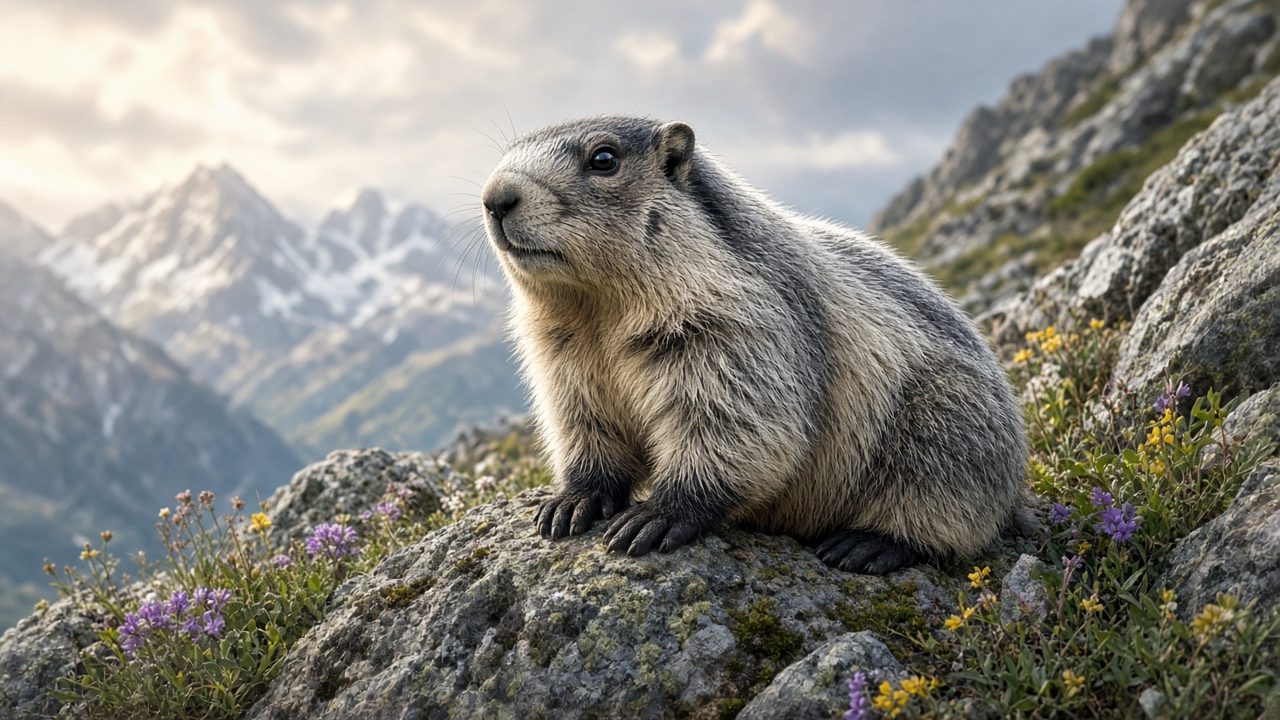
Hoary Marmot
Marmota caligataHoary Marmot (Marmota caligata): ecology sheet across its documented range — natural history and habitats, without hunting framing.
Seen in: Canada · United States
Overview
Hoary Marmot (Marmota caligata) is an ecology sheet across its documented range: natural history and habitats, without any hunting framing.
Classification: order Rodentia, family Sciuridae, genus Marmota. Common names: Hoary Marmot in English, Marmotte des Rocheuses in French, Marmota de las Rocosas in Spanish.
Identification
A large marmot weighing 8 to 10 kg and measuring 45 to 57 cm, with a 7 to 25 cm tail; males are slightly larger. The coat is mostly black and white with hoary tips, the base colour varying geographically. A white patch runs between the eyes and across the muzzle, the nose tip is white, and a black cap, larger than in other marmots, covers the head. Its black paws are unique among marmots and give it the name caligata, meaning “booted”.
Highly social, it lives in colonies made up of one adult male, a satellite male, one or more adult females, two-year-olds, yearlings and young of the year. Diurnal, it spends about 80% of its life in burrows and hibernates as a family from early September to mid-May. A herbivore, it eats vetches, sedges, fescues, mosses, lichens, willows and flowers. Females breed every other year: after about 4 weeks of gestation, 2 to 5 young are born (3.3 on average). Golden eagles, lynx, coyotes, grizzlies and wolverines prey on it.
Habitats and range
MDD gives its range as central Alaska, Yukon and the Northwest Territories south to western and north-eastern Washington, central Idaho and western Montana. ADW mentions the Alaska Peninsula and Alaska Range, the Ogilvie Mountains, the Cascades and the northern and central Rockies. It lives on rocky talus slopes and alpine tundra, at sea level in Alaska but only at high elevations in the south of its range.
The countries where the species’ presence is established are shown in the tags on this sheet.
Field signs
Burrow entrances are hard to spot, being simply gaps under or between large boulders. Look instead for animals sunning on rocks, mainly in the morning and late afternoon in summer, and greeting each other nose to nose. About 30% of time above ground goes on surveillance, and a loud, short alarm call signals a predator. Pikas eat its dried droppings.
Conservation
For conservation status of Marmota caligata, consult the current IUCN assessment and cross with national monitoring programmes in countries of documented presence. Never turn a global IUCN category into a local hunting rule. GBIF occurrences help situate distribution but remain effort-biased.
The IUCN lists it as Least Concern, with a stable population. Alaska nonetheless considers two endemic subspecies of concern: the Montague Island marmot (M. c. sheldoni), not seen since around 1900, and the Glacier Bay marmot (M. c. vigilis), presumed to be scarce; their taxonomic status remains uncertain and MDD treats both as synonyms.
Limits
This sheet on the Hoary Marmot covers biology and ecology only; it publishes no hunting season, quota or authorisation.
Local densities and management plans are not covered here: they are a matter for the managers of each area.
Sources
Sources consulted for this sheet:
- IUCN Red List — species search (consulted 2026-11-02)
- ASM Mammal Diversity Database — Marmota caligata (consulted 2026-11-02)
- GBIF — species search (consulted 2026-11-02)
- Animal Diversity Web — Marmota caligata (hoary marmot) (consulted 2026-11-04)
Conclusion
In short: use the scientific name Marmota caligata to cross-check sources, confirm taxonomy and conservation status on the institutional portals listed above, and relate every field sign to the habitat where it was actually found.
Identification
Marmota caligata
Marmotte des Rocheuses · preferred
Marmota de las Rocosas · preferred
Hoary Marmot · preferred
Classification
Class : Mammalia
Order : Rodentia
Family : Sciuridae
Genus : Marmota
Conservation
IUCN : LC
CITES : —
iucn · LC (global)
Habitat
Frequently asked questions
How do I recognise Hoary Marmot?
Use Marmota caligata as the scientific anchor. A large marmot weighing 8 to 10 kg and measuring 45 to 57 cm, with a 7 to 25 cm tail; males are slightly larger. The coat is mostly black and white with hoary tips, the base colour varying geographically. A white patch runs between the eyes and across the muzzle, the nose tip is...
Where does Hoary Marmot typically live?
MDD gives its range as central Alaska, Yukon and the Northwest Territories south to western and north-eastern Washington, central Idaho and western Montana. ADW mentions the Alaska Peninsula and Alaska Range, the Ogilvie Mountains, the Cascades and the northern and central Rockies. It lives on rocky talus slopes and alpine tundra, at sea level in Alaska but...
What field signs help confirm Hoary Marmot?
Burrow entrances are hard to spot, being simply gaps under or between large boulders. Look instead for animals sunning on rocks, mainly in the morning and late afternoon in summer, and greeting each other nose to nose. About 30% of time above ground goes on surveillance, and a loud, short alarm call signals a predator. Pikas eat its dried droppings.