Gray Seal
Halichoerus grypusGray Seal (Halichoerus grypus): coexistence sheet across its documented range — presence, biology and prudence, without an invented hunting status.
Seen in: Belgium · Denmark · Estonia · Finland · France
Overview
Gray Seal (Halichoerus grypus) is a coexistence sheet across its documented range: presence, biology and prudence — not a hunting status claim.
Classification: order Carnivora, family Phocidae, genus Halichoerus. Common names: Gray Seal in English, Phoque gris in French, Foca gris in Spanish.
Identification
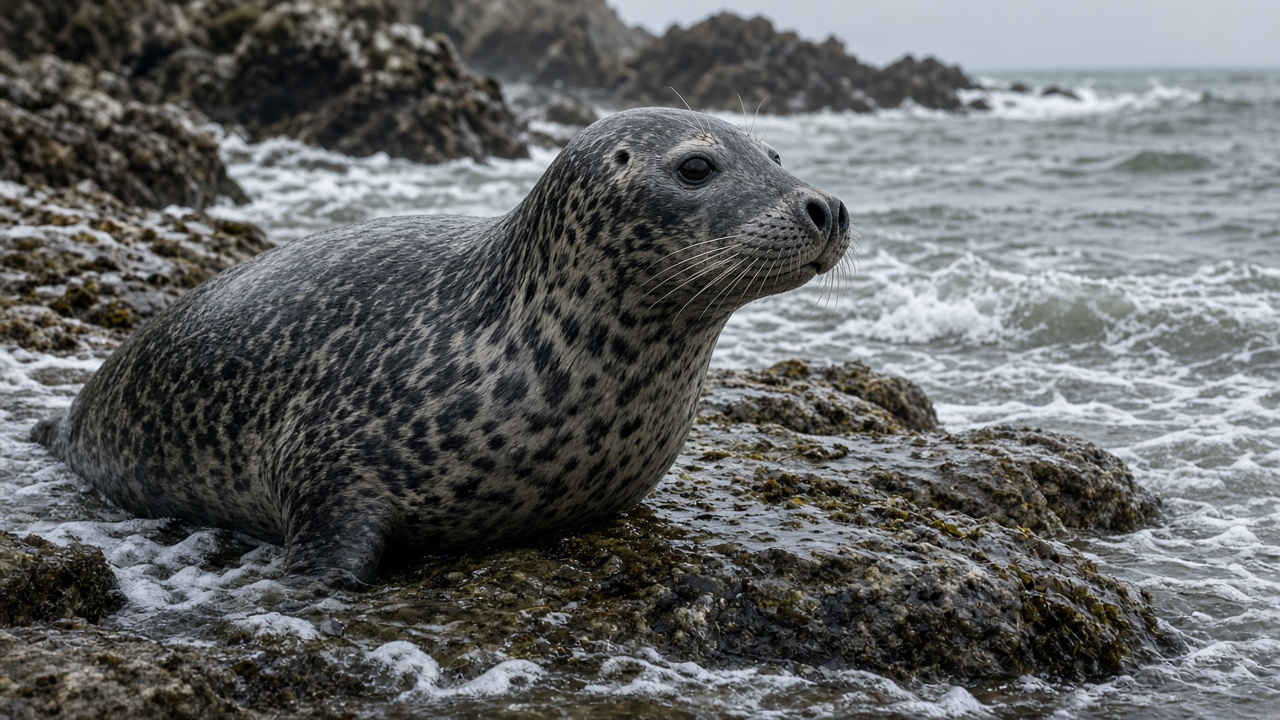
Adult males reach an average of 2.2 m and 220 kg at about 11 years; the smaller female only reaches full size at around 15 years, at about 1.8 m and 150 kg. Males have a long, arched “Roman nose”, the basis of the Latin name, and massive shoulders bulked out by scar tissue from fighting; females have a narrower nose and a straight head profile. Females are silver-grey with small scattered dark spots, males dark grey with silver-grey spots. At birth, pups weigh about 16 kg and wear long, creamy white fur.
An opportunistic feeder, it takes 4 to 6% of its body weight in one feeding a day, mostly fish – at least 29 species recorded, down to 70 m or more – and occasionally crustaceans and molluscs. Large fish are brought to the surface and held in the front flippers; the head is bitten off and discarded. Depending on the population, breeding falls anywhere between mid-December and October. After an eleven-month gestation a single pup is born and nursed for about two weeks, gaining 1.5 kg a day; the mother then mates and leaves it. On land, a male may mate with up to ten females.
Habitats and range
It lives in temperate and subarctic waters on both sides of the North Atlantic, in three populations: the western Atlantic, from Labrador to Nova Scotia; the eastern Atlantic, from Iceland, the Faroes and the British Isles to Norway and northwestern Russia, reaching French, Dutch, German and Portuguese coasts; and the Baltic Sea. Depending on the group, it uses rocky mainland coasts or isolated islands, or hauls out on ice. Breeding colonies form on sandy beaches, rocky islands, caves or ice.
The countries where the species’ presence is established are shown in the tags on this sheet.
Field signs
It forages underwater and spends the rest of its time on the shore, hauled out on rocks, beaches or ice. At rest, head shape separates the long-nosed male from the straight-profiled female. Non-migratory, it disperses widely after breeding; young seals may wander more than 1,000 km. In breeding colonies, creamy white pups stay alone on land after weaning until they have fully moulted.
Conservation
For conservation status of Halichoerus grypus, consult the current IUCN assessment, then cross with French monitoring programmes when they exist (OFB portal and related publications). Never turn a global IUCN category into a departmental hunting rule. GBIF occurrences help situate documented distribution but remain effort-biased.
The IUCN lists it as Least Concern. The Baltic population is much smaller than the two Atlantic ones, probably because of hunting and pollution: the sharp rise in DDT and PCB levels after 1955 has been linked to increased skull asymmetry. It hosts the cod worm (Pseudoterranova decipiens) and may remove fish from nets or damage traps and nets.
Limits
This sheet on the Gray Seal covers presence and biology. A species being present in a country does not mean it may be hunted, and no season or quota is published here.
Local densities and management plans are not covered here: they are a matter for the managers of each area.
Sources
Sources consulted for this sheet:
- IUCN Red List — species search (consulted 2026-11-01)
- ASM Mammal Diversity Database — Halichoerus grypus (consulted 2026-11-01)
- GBIF — species search (consulted 2026-11-01)
- Animal Diversity Web — Halichoerus grypus (gray seal) (consulted 2026-11-04)
Conclusion
In short: use the scientific name Halichoerus grypus to cross-check sources, confirm taxonomy and conservation status on the institutional portals listed above, and relate every field sign to the habitat where it was actually found.
Identification
Halichoerus grypus
Gray Seal · preferred
Phoque gris · preferred
Foca gris · preferred
Atlantic Seal
Horsehead
Classification
Class : Mammalia
Order : Carnivora
Family : Phocidae
Genus : Halichoerus
Conservation
IUCN : LC
CITES : —
iucn · LC (global)
Habitat
Frequently asked questions
How do I recognise Gray Seal?
Use Halichoerus grypus as the scientific anchor. Adult males reach an average of 2.2 m and 220 kg at about 11 years; the smaller female only reaches full size at around 15 years, at about 1.8 m and 150 kg. Males have a long, arched “Roman nose”, the basis of the Latin name, and massive shoulders bulked out by scar tissue from f...
Where does Gray Seal typically live?
It lives in temperate and subarctic waters on both sides of the North Atlantic, in three populations: the western Atlantic, from Labrador to Nova Scotia; the eastern Atlantic, from Iceland, the Faroes and the British Isles to Norway and northwestern Russia, reaching French, Dutch, German and Portuguese coasts; and the Baltic Sea. Depending on the group, it u...
What field signs help confirm Gray Seal?
It forages underwater and spends the rest of its time on the shore, hauled out on rocks, beaches or ice. At rest, head shape separates the long-nosed male from the straight-profiled female. Non-migratory, it disperses widely after breeding; young seals may wander more than 1,000 km. In breeding colonies, creamy white pups stay alone on land after weaning unt...