Desert Warthog
Phacochoerus aethiopicusNo solid country presence documented yet.
Desert Warthog (Phacochoerus aethiopicus): biology, habitats and field signs across its documented range, hunting-context reading.
Overview
Desert Warthog (Phacochoerus aethiopicus) is presented here in a hunting-context reading across its documented range: biology, habitats and field signs useful to observers — without publishing season, quota or authorisation.
Classification: order Artiodactyla, family Suidae, genus Phacochoerus. Common names: Desert Warthog in English, Phacochère du désert in French, Facóquero del desierto in Spanish.
Identification
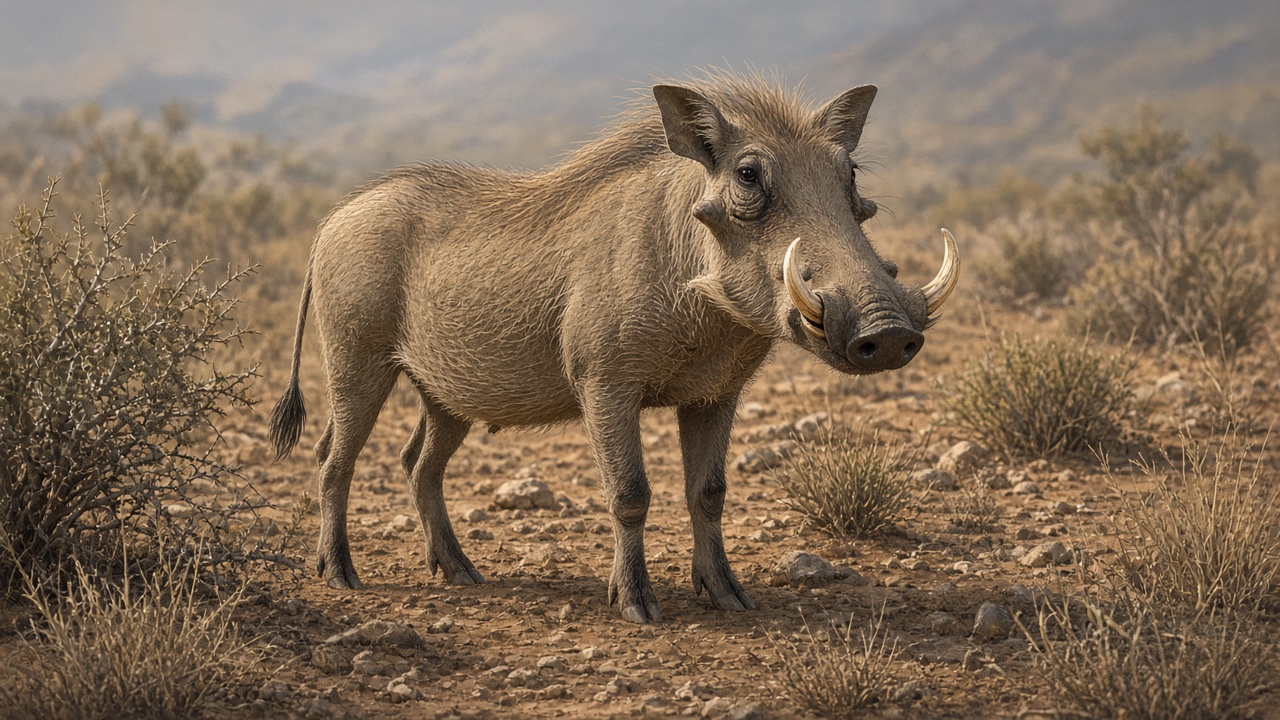
The desert warthog measures 100 to 145 cm, stands over 50 cm at the shoulder and weighs 45 to 130 kg (75 kg on average). Stocky, it has a large, somewhat flattened head, brown to dark brown skin with short, sparse hair, and a crest of long hair, sometimes partly whitish, along the back of the neck. Males, clearly larger, have much bigger facial warts and tusks. The clearest feature separating it from the common warthog is the lack of functional incisors; the common warthog is usually slightly larger.
A herbivore, it grazes mainly on grasses and digs up rhizomes, bulbs and tubers with its tusks and snout; it also eats shrubs, fruit (Balanites, Sclerocarya, figs) and, in hard times, insects or carrion. It lives in sounders of females and young led by the oldest sow. Mating peaks around early April, at the end of the wet season; after about 170 days, 2 to 3 piglets are born in a burrow, mostly in late September. Lions, leopards, cheetahs and spotted hyenas are its predators.
Habitats and range
MDD restricts it to north-eastern Africa: eastern Ethiopia, northern Kenya and Somalia; ADW adds that it was also known from South Africa, where it is extinct. A savanna species, it tolerates drought better than the common warthog and can live in arid, almost desert conditions, but avoids dense forest and thick undergrowth. With little tolerance of cold, it stays low, from about 0 to 1,000 m. Its home range, 3 to 4 km across, is often centred on a water hole.
The countries where the species’ presence is established are shown in the tags on this sheet.
Field signs
Strongly diurnal, it retreats to its burrow at dark, except where persecution has made it partly nocturnal. It digs deep burrows or takes over those of other species such as the aardvark, using up to ten; it backs in tail-first so its tusks face the attacker. It keeps to the shade in the heat of the day. In display it struts around a subordinate with crest and tail fully erect.
Conservation
For conservation status of Phacochoerus aethiopicus, consult the current IUCN assessment and cross with national monitoring programmes in countries of documented presence. Never turn a global IUCN category into a local hunting rule. GBIF occurrences help situate distribution but remain effort-biased.
The IUCN lists it as Least Concern; ADW nevertheless reports declining populations, under human persecution and competition with livestock for grazing. Long confused with the common warthog, Phacochoerus africanus, it was separated only recently, mainly on genetic grounds: much published warthog information combines the two species.
Limits
This sheet on the Desert Warthog publishes no season, quota, hunting method or fee: those rules differ between countries and territories and must be checked in official texts. Being described here does not mean a species may be hunted.
Local densities and management plans are not covered here: they are a matter for the managers of each area.
Sources
Sources consulted for this sheet:
- IUCN Red List — species search (consulted 2026-11-02)
- ASM Mammal Diversity Database — Phacochoerus aethiopicus (consulted 2026-11-02)
- GBIF — species search (consulted 2026-11-02)
- Animal Diversity Web — Phacochoerus aethiopicus (desert warthog) (consulted 2026-11-04)
Conclusion
In short: use the scientific name Phacochoerus aethiopicus to cross-check sources, confirm taxonomy and conservation status on the institutional portals listed above, and relate every field sign to the habitat where it was actually found.
Identification
Phacochoerus aethiopicus
Desert Warthog · preferred
Phacochère du désert · preferred
Facóquero del desierto · preferred
Classification
Class : Mammalia
Order : Artiodactyla
Family : Suidae
Genus : Phacochoerus
Conservation
IUCN : LC
CITES : —
iucn · LC (global)
Frequently asked questions
How do I recognise Desert Warthog?
Use Phacochoerus aethiopicus as the scientific anchor. The desert warthog measures 100 to 145 cm, stands over 50 cm at the shoulder and weighs 45 to 130 kg (75 kg on average). Stocky, it has a large, somewhat flattened head, brown to dark brown skin with short, sparse hair, and a crest of long hair, sometimes partly whitish, along th...
Where does Desert Warthog typically live?
MDD restricts it to north-eastern Africa: eastern Ethiopia, northern Kenya and Somalia; ADW adds that it was also known from South Africa, where it is extinct. A savanna species, it tolerates drought better than the common warthog and can live in arid, almost desert conditions, but avoids dense forest and thick undergrowth. With little tolerance of cold, it...
What field signs help confirm Desert Warthog?
Strongly diurnal, it retreats to its burrow at dark, except where persecution has made it partly nocturnal. It digs deep burrows or takes over those of other species such as the aardvark, using up to ten; it backs in tail-first so its tusks face the attacker. It keeps to the shade in the heat of the day. In display it struts around a subordinate with crest a...