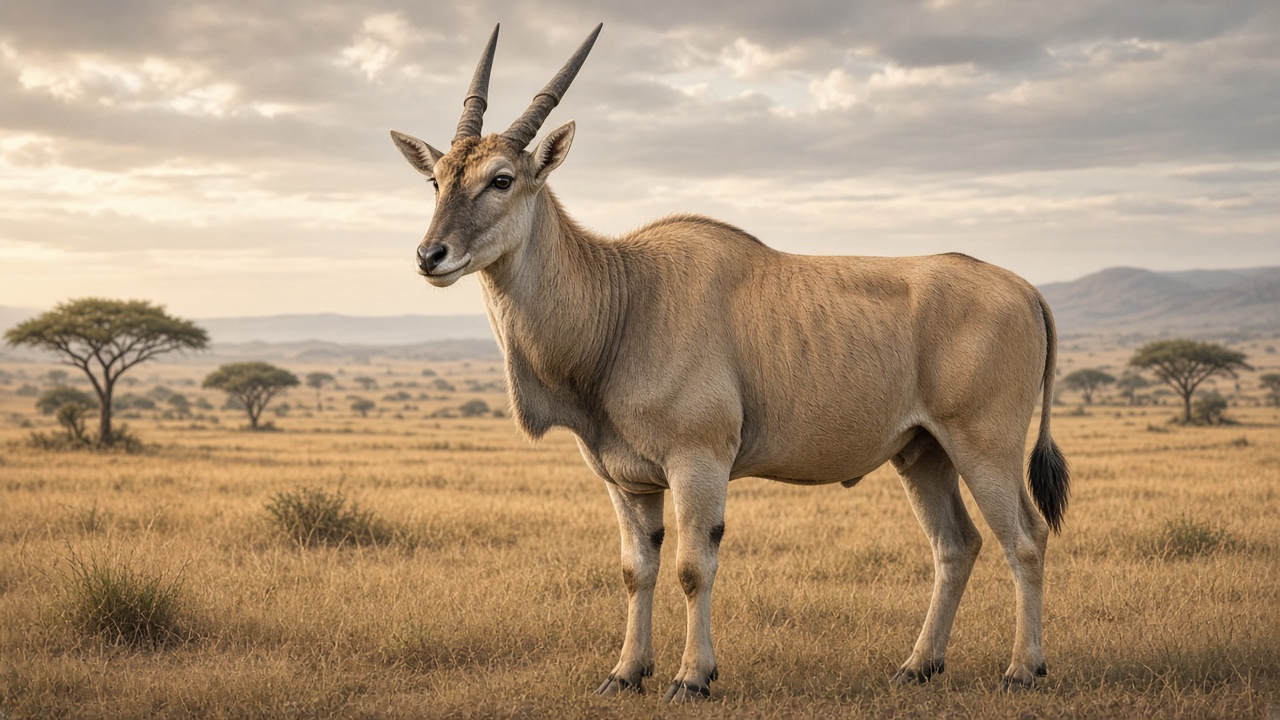
Common Eland
Tragelaphus oryxCommon Eland (Tragelaphus oryx): coexistence sheet across its documented range — presence, biology and prudence, without an invented hunting status.
Seen in: Namibia · South Africa
Overview
Common Eland (Tragelaphus oryx) is a coexistence sheet across its documented range: presence, biology and prudence — not a hunting status claim.
Classification: order Artiodactyla, family Bovidae, genus Tragelaphus. Common names: Common Eland in English, Éland du Cap in French, Eland común in Spanish.
Identification
The common eland is a giant antelope with marked sexual dimorphism: males weigh 400 to 1,000 kg, females 300 to 600 kg. The coat is a uniform fawn with a few thin vertical white stripes on the upper body. A dewlap hangs from the throat and neck; a short mane runs along the nape and males have long hair on the throat. Both sexes carry heavy, corkscrew-twisted horns, up to about 1.2 m in males and 67 cm in females. Despite its bulk, it can clear 1.5 m in a single jump.
It lives in herds of up to 25, which gather temporarily into large groups of females and calves in the wet season; a strict hierarchy among males controls access to females, and males fight by pushing horn against horn. In some areas, such as Zambia, births are concentrated in July–August. After 8.5 to 9 months of gestation a single calf is born, which lies hidden rather than following its mother; it is weaned at six months. It eats grasses, herbs, leaves of trees and bushes, and succulent fruit. Lions and African wild dogs are its natural enemies.
Habitats and range
MDD gives its range from Ethiopia (seasonally in the Omo Valley), South Sudan and Kenya south to South Africa, through Angola, Zambia, Mozambique, Namibia and Botswana; it is extinct in Burundi and has been reintroduced to Eswatini. It uses steppe, open woodland and semi-desert, up to about 4,400 m.
The countries where the species’ presence is established are shown in the tags on this sheet.
Field signs
In the heat of the day it is often found in shade. Females range widely in the wet season, while male territories lie mainly in wooded areas; calves tend to group together. The dewlap, striped fawn coat and spiral horns identify it at a distance. It drinks heavily when water is available but can go without in the dry season.
Conservation
For conservation status of Tragelaphus oryx, consult the current IUCN assessment and cross with national monitoring programmes in countries of documented presence. Never turn a global IUCN category into a local hunting rule. GBIF occurrences help situate distribution but remain effort-biased.
The IUCN lists it as Least Concern. Its populations have declined or disappeared in many areas, partly through overhunting, but it remains fairly common. MDD has moved it from the genus Taurotragus to Tragelaphus, with Taurotragus as a subgenus. Attempts have been made to domesticate it for its meat and its milk, which is richer in protein and fat than cow’s milk.
Limits
This sheet on the Common Eland covers presence and biology. A species being present in a country does not mean it may be hunted, and no season or quota is published here.
Local densities and management plans are not covered here: they are a matter for the managers of each area.
Sources
Sources consulted for this sheet:
- IUCN Red List — species search (consulted 2026-11-02)
- ASM Mammal Diversity Database — Tragelaphus oryx (consulted 2026-11-02)
- GBIF — species search (consulted 2026-11-02)
- Animal Diversity Web — Taurotragus oryx (eland), synonym of Tragelaphus oryx (consulted 2026-11-04)
Conclusion
In short: use the scientific name Tragelaphus oryx to cross-check sources, confirm taxonomy and conservation status on the institutional portals listed above, and relate every field sign to the habitat where it was actually found.
Identification
Tragelaphus oryx
Éland du Cap · preferred
Eland común · preferred
Common Eland · preferred
Cape Eland
East African Eland
Livingstone's Eland
Taurotragus oryx
Classification
Class : Mammalia
Order : Artiodactyla
Family : Bovidae
Genus : Tragelaphus
Conservation
IUCN : LC
CITES : —
iucn · LC (global)
Habitat
Frequently asked questions
How do I recognise Common Eland?
Use Tragelaphus oryx as the scientific anchor. The common eland is a giant antelope with marked sexual dimorphism: males weigh 400 to 1,000 kg, females 300 to 600 kg. The coat is a uniform fawn with a few thin vertical white stripes on the upper body. A dewlap hangs from the throat and neck; a short mane runs along the nape a...
Where does Common Eland typically live?
MDD gives its range from Ethiopia (seasonally in the Omo Valley), South Sudan and Kenya south to South Africa, through Angola, Zambia, Mozambique, Namibia and Botswana; it is extinct in Burundi and has been reintroduced to Eswatini. It uses steppe, open woodland and semi-desert, up to about 4,400 m.
What field signs help confirm Common Eland?
In the heat of the day it is often found in shade. Females range widely in the wet season, while male territories lie mainly in wooded areas; calves tend to group together. The dewlap, striped fawn coat and spiral horns identify it at a distance. It drinks heavily when water is available but can go without in the dry season.