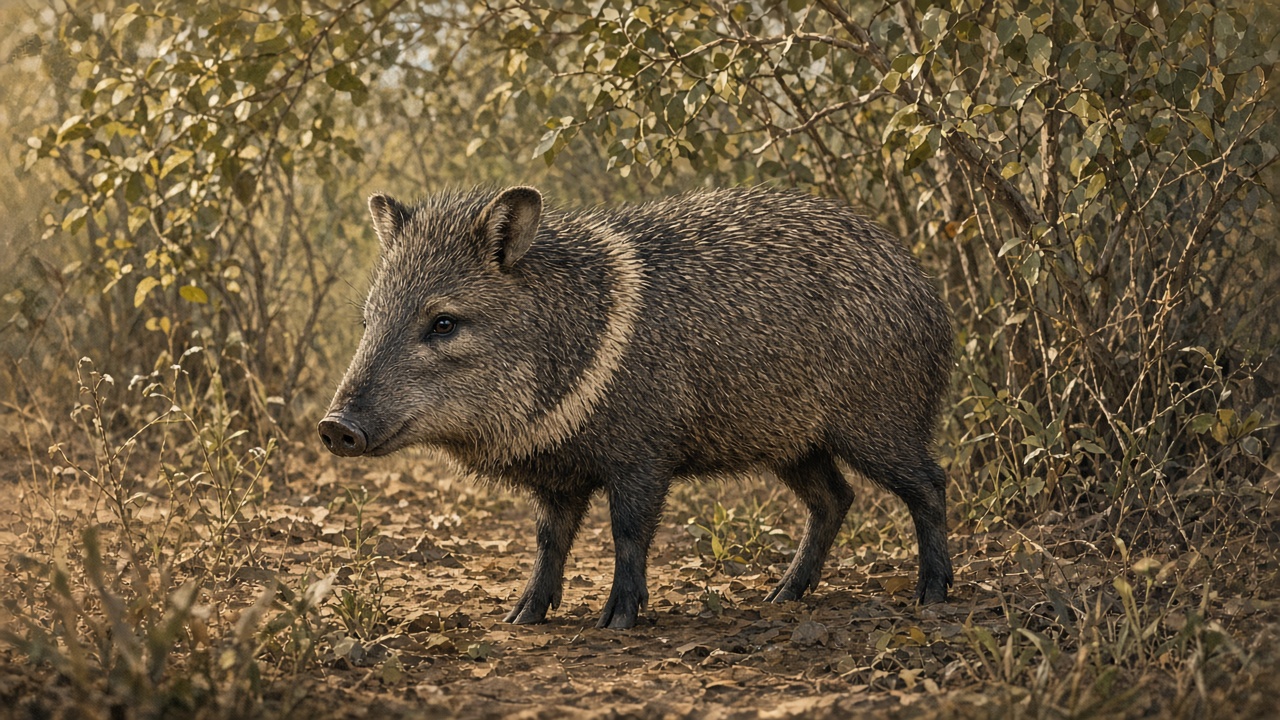
Collared Peccary
Dicotyles tajacuCollared Peccary (Dicotyles tajacu): coexistence sheet across its documented range — presence, biology and prudence, without an invented hunting status.
Seen in: Brazil · Mexico
Overview
Collared Peccary (Dicotyles tajacu) is a coexistence sheet across its documented range: presence, biology and prudence — not a hunting status claim.
Classification: order Artiodactyla, family Tayassuidae, genus Dicotyles. Common names: Collared Peccary in English, Pécari à collier in French, Pecarí de collar in Spanish.
Identification
The collared peccary is 84 to 106 cm long and 30 to 50 cm at the shoulder, weighing 15 to 28 kg and up to 40 to 42 kg in Arizona and Peru. Its rough grey to greyish-black coat has a whitish collar just in front of the shoulders; it turns dark yellowish-brown in deserts and darker in the tropics. The tail is about 1.2 cm long. The protruding lower canines form tusks, larger in males. Young are reddish-brown with a dark dorsal stripe.
An omnivore that eats mostly plants: in semi-arid areas, chiefly cacti such as prickly pear, which also supply water, plus roots, herbs and some insects; in tropical forest it is mainly a fruit eater. It lives in herds of 5 to 15 led by a dominant male. Breeding takes place year-round, peaking in the rainy season; after 142 to 151 days, usually 2 young are born and weaned at about 6 weeks. Jaguars, pumas and coyotes are its main predators.
Habitats and range
It ranges from southern Arizona, New Mexico and Texas through Mexico, except its central part, all of Central America and South America east of the Andes to northern Argentina, plus Trinidad; it has been introduced to Cuba. It uses tropical forest, woodland, semi-arid desert, grassland, pasture and rocky canyons, from sea level to 3,000 m. Groups sleep in cool spots such as burrows, caves or the bases of large trees.
The countries where the species’ presence is established are shown in the tags on this sheet.
Field signs
Nocturnal in summer and diurnal in winter, it becomes crepuscular in open habitats, the herd then spreading out over more than 30 m. When provoked it clacks its teeth; facing a predator, it huffs and grunts while stamping. A dorsal scent gland in front of the tail is used to mark trees and rocks. It digs and keeps up water and mud wallows that other species also use.
Conservation
For conservation status of Dicotyles tajacu, consult the current IUCN assessment and cross with national monitoring programmes in countries of documented presence. Never turn a global IUCN category into a local hunting rule. GBIF occurrences help situate distribution but remain effort-biased.
According to ADW, the IUCN lists it as Least Concern (MDD shows it as Not Evaluated under Dicotyles); it is in CITES Appendix II, except for the populations of the United States and Mexico. The threats described are habitat loss and fragmentation and overexploitation for meat and hides. MDD replaced the genus name Pecari with Dicotyles and includes crassus, angulatus and maximus in the species.
Limits
This sheet on the Collared Peccary covers presence and biology. A species being present in a country does not mean it may be hunted, and no season or quota is published here.
Local densities and management plans are not covered here: they are a matter for the managers of each area.
Sources
Sources consulted for this sheet:
- IUCN Red List — species search (consulted 2026-11-02)
- ASM Mammal Diversity Database — Dicotyles tajacu (consulted 2026-11-02)
- GBIF — species search (consulted 2026-11-02)
- Animal Diversity Web — Pecari tajacu (collared peccary) (consulted 2026-11-04)
Conclusion
In short: use the scientific name Dicotyles tajacu to cross-check sources, confirm taxonomy and conservation status on the institutional portals listed above, and relate every field sign to the habitat where it was actually found.
Identification
Dicotyles tajacu
Collared Peccary · preferred
Pécari à collier · preferred
Pecarí de collar · preferred
Javelina
Pecari tajacu
Classification
Class : Mammalia
Order : Artiodactyla
Family : Tayassuidae
Genus : Dicotyles
Conservation
IUCN : LC
CITES : —
iucn · LC (global)
Habitat
Frequently asked questions
How do I recognise Collared Peccary?
Use Dicotyles tajacu as the scientific anchor. The collared peccary is 84 to 106 cm long and 30 to 50 cm at the shoulder, weighing 15 to 28 kg and up to 40 to 42 kg in Arizona and Peru. Its rough grey to greyish-black coat has a whitish collar just in front of the shoulders; it turns dark yellowish-brown in deserts and darker...
Where does Collared Peccary typically live?
It ranges from southern Arizona, New Mexico and Texas through Mexico, except its central part, all of Central America and South America east of the Andes to northern Argentina, plus Trinidad; it has been introduced to Cuba. It uses tropical forest, woodland, semi-arid desert, grassland, pasture and rocky canyons, from sea level to 3,000 m. Groups sleep in co...
What field signs help confirm Collared Peccary?
Nocturnal in summer and diurnal in winter, it becomes crepuscular in open habitats, the herd then spreading out over more than 30 m. When provoked it clacks its teeth; facing a predator, it huffs and grunts while stamping. A dorsal scent gland in front of the tail is used to mark trees and rocks. It digs and keeps up water and mud wallows that other species...