Cheetah
Acinonyx jubatusCheetah (Acinonyx jubatus): coexistence sheet across its documented range — presence, biology and prudence, without an invented hunting status.
Seen in: Namibia · South Africa
Overview
Cheetah (Acinonyx jubatus) is a coexistence sheet across its documented range: presence, biology and prudence — not a hunting status claim.
Classification: order Carnivora, family Felidae, genus Acinonyx. Common names: Cheetah in English, Guépard in French, Guepardo in Spanish.
Identification
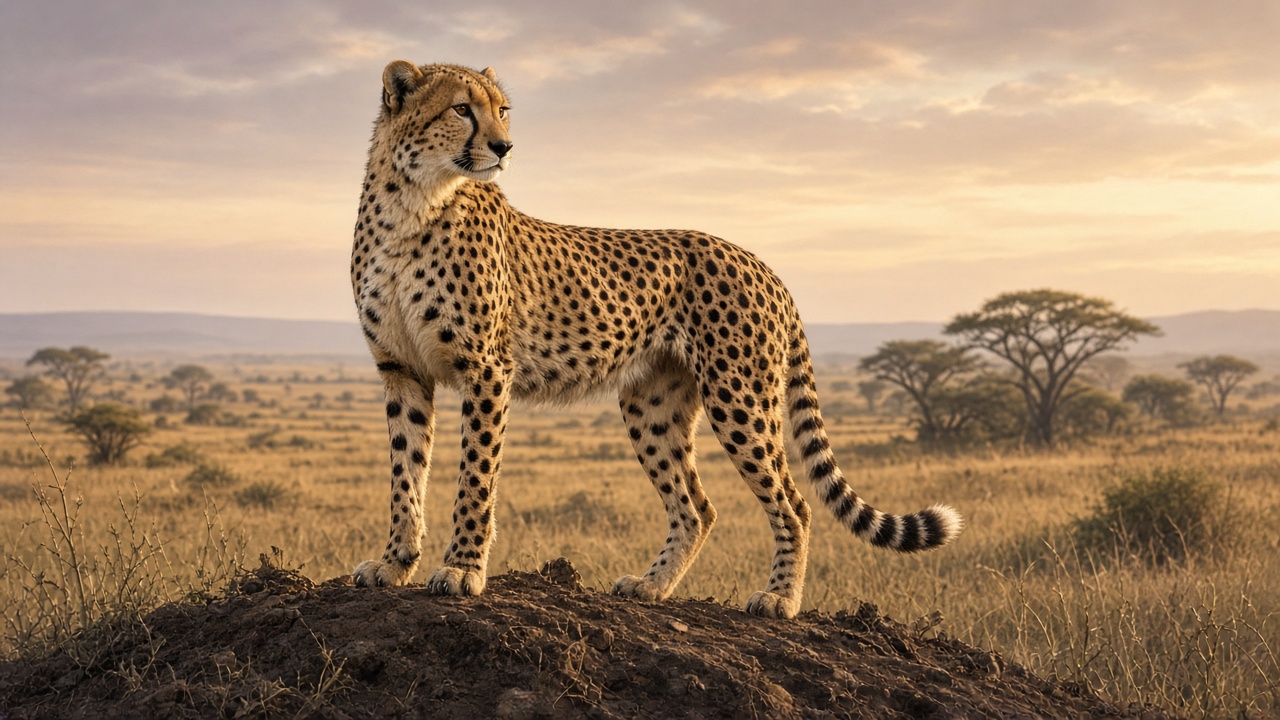
A slender, long-legged cat with a small rounded head and short ears: 112 to 150 cm in body length, 60 to 80 cm of tail, 67 to 94 cm at the shoulder and 21 to 72 kg, males being larger on average. The pale yellow, grey or fawn coat is covered with small, round, closely set black spots; a black “tear line” runs from the corner of the eye down the muzzle. The last third of the tail has dark rings and ends in a white tip. The claws are weakly retractile and blunt. Cubs have a long grey mane along the back.
Diurnal, it hunts mainly gazelles, especially Thomson’s gazelle, impala and other small to medium ungulates, and hares and birds when these are scarce. Rather than stalking close, it charges from 70 to 100 m at 80 to 112 km/h over no more than 500 m; most hunts fail. Females are solitary and breed year-round; after 90 to 95 days an average of 2.6 cubs are born, hidden for about eight weeks, and stay with their mother until 15 to 17 months. Lions, hyenas and leopards kill cubs; lions and hyenas also steal its kills.
Habitats and range
It once ranged across Africa, except tropical forest and the central Sahara, and from Palestine and Arabia to Tajikistan and central India. MDD still lists it in some twenty African countries, from Algeria, Mali and Niger to South Africa, and in Iran; it has recently disappeared from Morocco, India, Pakistan and the Arabian Peninsula, among others. It favours grasslands and deserts, with home ranges of 50 to 130 km².
The countries where the species’ presence is established are shown in the tags on this sheet.
Field signs
Territorial males mark their area with urine, rake the ground with their hind paws, claw trees, flatten grass by rolling and leave droppings on prominent features. Separated coalition males call to each other with “yips” and churrs for up to twenty minutes. Two females that spot each other may watch one another from as far as 2 km.
Conservation
For conservation status of Acinonyx jubatus, consult the current IUCN assessment and cross with national monitoring programmes in countries of documented presence. Never turn a global IUCN category into a local hunting rule. GBIF occurrences help situate distribution but remain effort-biased.
The IUCN lists it as Vulnerable. Its very low genetic diversity, probably due to an ancient bottleneck, makes it sensitive to disease and disturbance. Treated as vermin by settlers, it is still persecuted for livestock losses in Namibia and Zimbabwe, although most range countries protect it. The “king cheetah”, described in 1927 as Acinonyx rex, is simply a variant with dark bars.
Limits
This sheet on the Cheetah covers presence and biology. A species being present in a country does not mean it may be hunted, and no season or quota is published here.
Local densities and management plans are not covered here: they are a matter for the managers of each area.
Sources
Sources consulted for this sheet:
- IUCN Red List — species search (consulted 2026-11-02)
- ASM Mammal Diversity Database — Acinonyx jubatus (consulted 2026-11-02)
- GBIF — species search (consulted 2026-11-02)
- Animal Diversity Web — Acinonyx jubatus (cheetah) (consulted 2026-11-04)
Conclusion
In short: use the scientific name Acinonyx jubatus to cross-check sources, confirm taxonomy and conservation status on the institutional portals listed above, and relate every field sign to the habitat where it was actually found.
Identification
Acinonyx jubatus
Cheetah · preferred
Guépard · preferred
Guepardo · preferred
Classification
Class : Mammalia
Order : Carnivora
Family : Felidae
Genus : Acinonyx
Conservation
IUCN : VU
CITES : —
iucn · VU (global)
Habitat
Frequently asked questions
How do I recognise Cheetah?
Use Acinonyx jubatus as the scientific anchor. A slender, long-legged cat with a small rounded head and short ears: 112 to 150 cm in body length, 60 to 80 cm of tail, 67 to 94 cm at the shoulder and 21 to 72 kg, males being larger on average. The pale yellow, grey or fawn coat is covered with small, round, closely set black s...
Where does Cheetah typically live?
It once ranged across Africa, except tropical forest and the central Sahara, and from Palestine and Arabia to Tajikistan and central India. MDD still lists it in some twenty African countries, from Algeria, Mali and Niger to South Africa, and in Iran; it has recently disappeared from Morocco, India, Pakistan and the Arabian Peninsula, among others. It favour...
What field signs help confirm Cheetah?
Territorial males mark their area with urine, rake the ground with their hind paws, claw trees, flatten grass by rolling and leave droppings on prominent features. Separated coalition males call to each other with “yips” and churrs for up to twenty minutes. Two females that spot each other may watch one another from as far as 2 km.