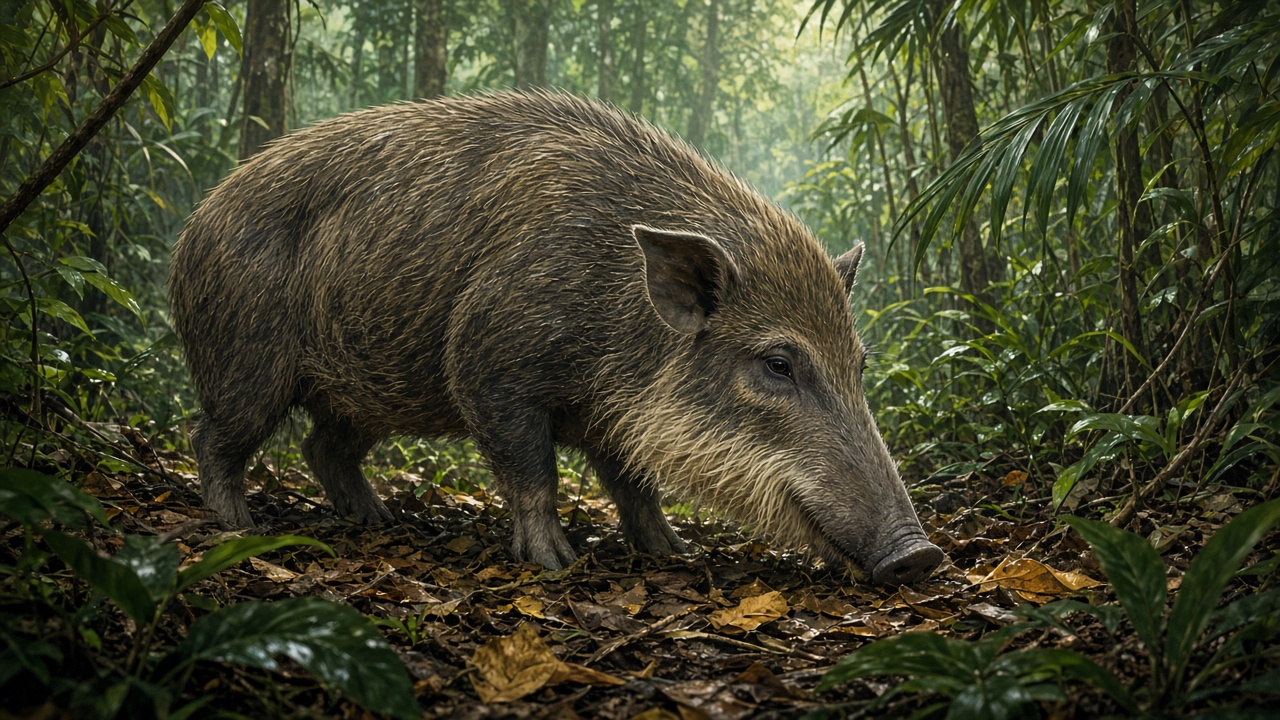
Bearded Pig
Sus barbatusNo solid country presence documented yet.
Bearded Pig (Sus barbatus): biology, habitats and field signs across its documented range, hunting-context reading.
Overview
Bearded Pig (Sus barbatus) is presented here in a hunting-context reading across its documented range: biology, habitats and field signs useful to observers — without publishing season, quota or authorisation.
Classification: order Artiodactyla, family Suidae, genus Sus. Common names: Bearded Pig in English, Sanglier à barbe in French, Cerdo barbudo in Spanish.
Identification
The bearded pig has the slimmest body and the longest head of all living pigs. Its dark grey-brown coat contrasts with a conspicuous white beard on the face; two pairs of facial warts, the first hidden by the beard, thin whiskers and a tail tuft in two rows of hair complete the picture. The eyes are small and the ears fairly long. It measures roughly 1 to 1.7 m long and 73 to 85 cm at the shoulder, with a 20 to 30 cm tail; published weights range from 41 to 150 kg depending on the source.
It digs with its long snout for earthworms and roots, and also eats fruit and seedlings; it often follows troops of macaques to take the fruit they drop and, on the coast, eats dead fish washed ashore. After a gestation of about four months, the female leaves the group and builds a nest of fern fronds, twigs and dry palm fronds up to 1.8 m across; there she gives birth to 2 to 8 striped piglets (often only 2 or 3 on Borneo), which stay in the nest for ten days and are weaned at three months.
Habitats and range
MDD lists it from Brunei, Indonesia (Kalimantan, Sumatra, Bangka, Riau Archipelago) and Malaysia (Malay Peninsula and Sarawak). The older ADW account also includes Karimata, Sibutu and Tawitawi in the Sulu Archipelago, and Balabac, Palawan and the Calamian Islands in the Philippines, which MDD does not assign to this species. It lives in rainforest, mangrove thickets and secondary forest; females place their farrowing nest on raised ground within a thicket.
The countries where the species’ presence is established are shown in the tags on this sheet.
Field signs
For most of the year it lives in a stable family group in one area and is active by day. During its migrations, unique among pigs, several hundred animals led by old boars travel at night along wide, well-worn paths, always by the same route and at the same time of year, and retreat into thickets by day; they are then far less shy. Large nests of vegetation mark farrowing sites.
Conservation
For conservation status of Sus barbatus, consult the current IUCN assessment and cross with national monitoring programmes in countries of documented presence. Never turn a global IUCN category into a local hunting rule. GBIF occurrences help situate distribution but remain effort-biased.
The IUCN lists it as Vulnerable. ADW reports a decline due to habitat destruction, although the species remains fairly common, and notes that its predictable migrations leave it highly exposed to human take along the routes. Data on its size, sexual dimorphism and lifespan remain patchy. MDD lists among its synonyms Sus oi, described from Sumatra, and Sus gargantua, from south-eastern Borneo.
Limits
This sheet on the Bearded Pig publishes no season, quota, hunting method or fee: those rules differ between countries and territories and must be checked in official texts. Being described here does not mean a species may be hunted.
Local densities and management plans are not covered here: they are a matter for the managers of each area.
Sources
Sources consulted for this sheet:
- IUCN Red List — species search (consulted 2026-11-02)
- ASM Mammal Diversity Database — Sus barbatus (consulted 2026-11-02)
- GBIF — species search (consulted 2026-11-02)
- Animal Diversity Web — Sus barbatus (bearded pig) (consulted 2026-11-04)
Conclusion
In short: use the scientific name Sus barbatus to cross-check sources, confirm taxonomy and conservation status on the institutional portals listed above, and relate every field sign to the habitat where it was actually found.
Identification
Sus barbatus
Sanglier à barbe · preferred
Cerdo barbudo · preferred
Bearded Pig · preferred
Classification
Class : Mammalia
Order : Artiodactyla
Family : Suidae
Genus : Sus
Conservation
IUCN : VU
CITES : —
iucn · VU (global)
Frequently asked questions
How do I recognise Bearded Pig?
Use Sus barbatus as the scientific anchor. The bearded pig has the slimmest body and the longest head of all living pigs. Its dark grey-brown coat contrasts with a conspicuous white beard on the face; two pairs of facial warts, the first hidden by the beard, thin whiskers and a tail tuft in two rows of hair complete the p...
Where does Bearded Pig typically live?
MDD lists it from Brunei, Indonesia (Kalimantan, Sumatra, Bangka, Riau Archipelago) and Malaysia (Malay Peninsula and Sarawak). The older ADW account also includes Karimata, Sibutu and Tawitawi in the Sulu Archipelago, and Balabac, Palawan and the Calamian Islands in the Philippines, which MDD does not assign to this species. It lives in rainforest, mangrove...
What field signs help confirm Bearded Pig?
For most of the year it lives in a stable family group in one area and is active by day. During its migrations, unique among pigs, several hundred animals led by old boars travel at night along wide, well-worn paths, always by the same route and at the same time of year, and retreat into thickets by day; they are then far less shy. Large nests of vegetation...