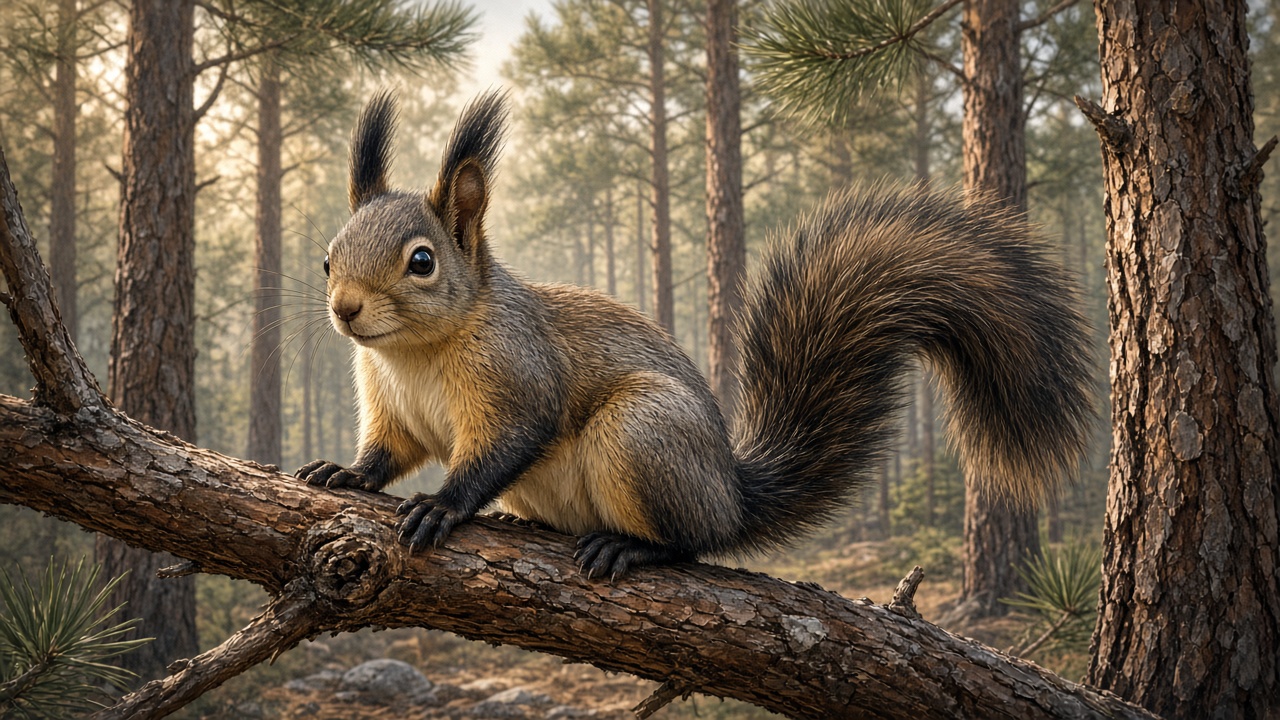
Abert's Squirrel (Sciurus aberti): ecology sheet across its documented range — natural history and habitats, without hunting framing.
Seen in: United States
Overview
Abert's Squirrel (Sciurus aberti) is an ecology sheet across its documented range: natural history and habitats, without any hunting framing.
Classification: order Rodentia, family Sciuridae, genus Sciurus. Common names: Abert's Squirrel in English, Écureuil d'Abert in French, Ardilla de Abert in Spanish.
Identification
A tree squirrel 450 to 580 mm in total length and 540 to 971 g (620 g on average). Its defining feature is the long tufts of hair on its ears, hence its other name, tassel-eared squirrel; adults lose them from July to September. Seven of the nine subspecies are grey, the other two black or brown; a reddish stripe often runs down the back, well marked north of the Grand Canyon and faded or absent further east. Melanistic animals are common in northern Colorado. There is no obvious sexual dimorphism.
Diurnal, active from just before sunrise to just before sunset, it stores little or no food and must forage constantly: cones, buds, seeds, fungi and above all the inner bark of ponderosa pine twigs, its main food from autumn to spring. Non-territorial, it sometimes shares nests. Mating runs from late February to early June; after a 43-day gestation 1 to 5 young (3.5 on average) are born and weaned at about 70 days. Northern goshawks, cougars, bobcats and coyotes are its predators.
Habitats and range
MDD gives it in south-eastern Utah, southern and western Colorado, extreme south-eastern Wyoming, western and central New Mexico, Arizona and, in Mexico, Chihuahua, Durango and Sonora. Its isolated populations follow the distribution of ponderosa pine, between 1,830 and 2,590 m (mostly 2,160 to 2,380 m); in New Mexico and Mexico it also uses mixed forest. It nests in clumps of pines with interlocking crowns.
The countries where the species’ presence is established are shown in the tags on this sheet.
Field signs
Its ball-shaped nests of pine twigs, set against the trunk on a branch, or built into dwarf-mistletoe “witches’ brooms”, can be seen in ponderosas. In spring, a female may be followed for around eleven hours by a line of males led by a dominant one. Its calls (clucks, barks, screeches) are higher-pitched than those of nearby squirrel species. It forages little on windy or snowy days.
Conservation
For conservation status of Sciurus aberti, consult the current IUCN assessment and cross with national monitoring programmes in countries of documented presence. Never turn a global IUCN category into a local hunting rule. GBIF occurrences help situate distribution but remain effort-biased.
The IUCN lists it as Least Concern. Its populations are stable but isolated; the main threat cited by ADW is clear-cutting. It has been introduced to other parts of Utah, New Mexico and Arizona; in the Pinaleño Mountains it competes with the endangered Mount Graham red squirrel. MDD notes that a proposed arrangement would move it, with S. griseus, to the genus Hesperosciurus, which MDD does not follow for now.
Limits
This sheet on the Abert's Squirrel covers biology and ecology only; it publishes no hunting season, quota or authorisation.
Local densities and management plans are not covered here: they are a matter for the managers of each area.
Sources
Sources consulted for this sheet:
- IUCN Red List — species search (consulted 2026-11-02)
- ASM Mammal Diversity Database — Sciurus aberti (consulted 2026-11-02)
- GBIF — species search (consulted 2026-11-02)
- Animal Diversity Web — Sciurus aberti (Abert’s squirrel) (consulted 2026-11-04)
Conclusion
In short: use the scientific name Sciurus aberti to cross-check sources, confirm taxonomy and conservation status on the institutional portals listed above, and relate every field sign to the habitat where it was actually found.
Identification
Sciurus aberti
Écureuil d'Abert · preferred
Ardilla de Abert · preferred
Abert's Squirrel · preferred
Tassel-eared Squirrel
Kaibab Squirrel
Classification
Class : Mammalia
Order : Rodentia
Family : Sciuridae
Genus : Sciurus
Conservation
IUCN : LC
CITES : —
iucn · LC (global)
Habitat
Frequently asked questions
How do I recognise Abert's Squirrel?
Use Sciurus aberti as the scientific anchor. A tree squirrel 450 to 580 mm in total length and 540 to 971 g (620 g on average). Its defining feature is the long tufts of hair on its ears, hence its other name, tassel-eared squirrel; adults lose them from July to September. Seven of the nine subspecies are grey, the other tw...
Where does Abert's Squirrel typically live?
MDD gives it in south-eastern Utah, southern and western Colorado, extreme south-eastern Wyoming, western and central New Mexico, Arizona and, in Mexico, Chihuahua, Durango and Sonora. Its isolated populations follow the distribution of ponderosa pine, between 1,830 and 2,590 m (mostly 2,160 to 2,380 m); in New Mexico and Mexico it also uses mixed forest. It...
What field signs help confirm Abert's Squirrel?
Its ball-shaped nests of pine twigs, set against the trunk on a branch, or built into dwarf-mistletoe “witches’ brooms”, can be seen in ponderosas. In spring, a female may be followed for around eleven hours by a line of males led by a dominant one. Its calls (clucks, barks, screeches) are higher-pitched than those of nearby squirrel species. It forages litt...