Aardvark
Orycteropus aferAardvark (Orycteropus afer): coexistence sheet across its documented range — presence, biology and prudence, without an invented hunting status.
Seen in: Namibia · South Africa
Overview
Aardvark (Orycteropus afer) is a coexistence sheet across its documented range: presence, biology and prudence — not a hunting status claim.
Classification: order Tubulidentata, family Orycteropodidae, genus Orycteropus. Common names: Aardvark in English, Oryctérope in French, Cerdo hormiguero in Spanish.
Identification
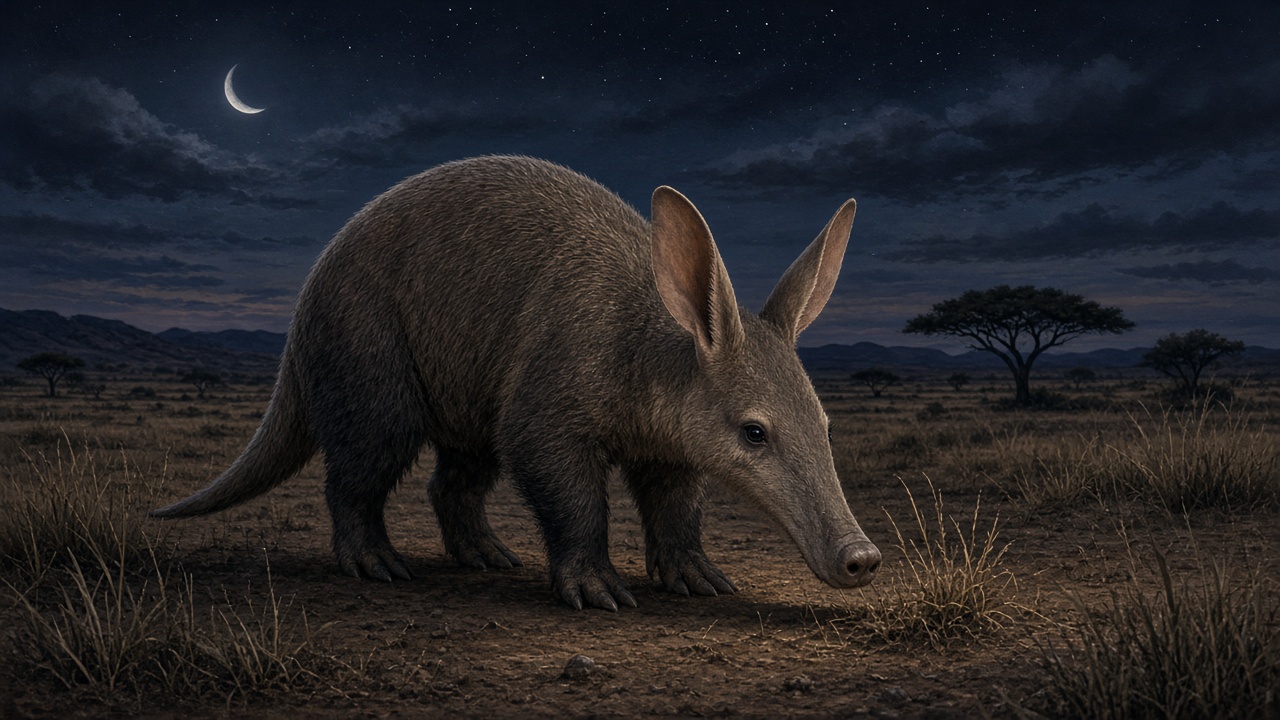
About the size of a small pig, the aardvark weighs 40 to 82 kg and measures 100 to 158 cm. It has a long snout that widens at the tip, a squared-off head, long mobile ears and a tail that tapers to a point. The body is massive and the skin very thick; the hair, short on the head, neck and tail and longer and darker on the limbs, is often worn away in adults. The sides of the face and the tail are pale, lighter in females. The very muscular limbs end in spade-like claws, four on the forelimbs and five behind.
Solitary, territorial and very shy, it forages at night over 2 to 5 km. A specialist on ants and termites, mostly ants, it digs into their mounds and sweeps the insects up with its long, sticky tongue, swallowing with little or no chewing. Usually a single young is born after about 7 months of gestation: October–November in northern Africa, May–July in South Africa. The young follows its mother at 2 weeks, is weaned at 3 months and independent at about 6 months. Lions, hyenas and leopards prey on it.
Habitats and range
It occurs throughout sub-Saharan Africa except the rainforests of West and Central Africa; MDD describes it from the savanna zones of West Africa to Ethiopia and South Africa. It lives in grassland and savanna with plenty of ants and termites year-round, avoiding hard, compact soils, rocky ground and frequently flooded areas. Home ranges cover 2 to 5 km², at very low densities.
The countries where the species’ presence is established are shown in the tags on this sheet.
Field signs
Rarely seen, it reveals itself through its tracks, burrows and the scratch marks left by its powerful claws. Burrows may be simple holes a few metres long or complex systems with eight or more entrances reaching 6 m underground; the entrance is often plugged, leaving a vent at the top. Leaving its den, it pauses to look around, then bounds out and jumps several times before trotting off.
Conservation
For conservation status of Orycteropus afer, consult the current IUCN assessment and cross with national monitoring programmes in countries of documented presence. Never turn a global IUCN category into a local hunting rule. GBIF occurrences help situate distribution but remain effort-biased.
The IUCN lists it as Least Concern. It has nonetheless been wiped out in many farming areas and declines where human populations are dense: farmers kill it because of its holes, and cultivation and pesticides remove its prey. Its burrows shelter hyenas, warthogs, mongooses, bats, birds and reptiles. The only living member of the order Tubulidentata, it belongs to the Afrotheria.
Limits
This sheet on the Aardvark covers presence and biology. A species being present in a country does not mean it may be hunted, and no season or quota is published here.
Local densities and management plans are not covered here: they are a matter for the managers of each area.
Sources
Sources consulted for this sheet:
- IUCN Red List — species search (consulted 2026-11-02)
- ASM Mammal Diversity Database — Orycteropus afer (consulted 2026-11-02)
- GBIF — species search (consulted 2026-11-02)
- Animal Diversity Web — Orycteropus afer (aardvark) (consulted 2026-11-04)
Conclusion
In short: use the scientific name Orycteropus afer to cross-check sources, confirm taxonomy and conservation status on the institutional portals listed above, and relate every field sign to the habitat where it was actually found.
Identification
Orycteropus afer
Oryctérope · preferred
Cerdo hormiguero · preferred
Aardvark · preferred
Antbear
Classification
Class : Mammalia
Order : Tubulidentata
Family : Orycteropodidae
Genus : Orycteropus
Conservation
IUCN : LC
CITES : —
iucn · LC (global)
Habitat
Frequently asked questions
How do I recognise Aardvark?
Use Orycteropus afer as the scientific anchor. About the size of a small pig, the aardvark weighs 40 to 82 kg and measures 100 to 158 cm. It has a long snout that widens at the tip, a squared-off head, long mobile ears and a tail that tapers to a point. The body is massive and the skin very thick; the hair, short on the head,...
Where does Aardvark typically live?
It occurs throughout sub-Saharan Africa except the rainforests of West and Central Africa; MDD describes it from the savanna zones of West Africa to Ethiopia and South Africa. It lives in grassland and savanna with plenty of ants and termites year-round, avoiding hard, compact soils, rocky ground and frequently flooded areas. Home ranges cover 2 to 5 km², at...
What field signs help confirm Aardvark?
Rarely seen, it reveals itself through its tracks, burrows and the scratch marks left by its powerful claws. Burrows may be simple holes a few metres long or complex systems with eight or more entrances reaching 6 m underground; the entrance is often plugged, leaving a vent at the top. Leaving its den, it pauses to look around, then bounds out and jumps seve...